



- Home
- EXPERIENCES
- STORIES AND FEATURES
- "YOU GET HOOKED STING BY STING": A PASSION FOR BEES
"You get hooked sting by sting": A Passion for Bees
 REPORT
 REPORT
 REPORT
 REPORT
 REPORT
 REPORT
Kike Andreu, beekeeper and president of the Menorcan Beekeepers’ Association, advocates for local, sustainable beekeeping underpinned by expert training.
Kike Andreu (Sant Lluís, 1971) chairs the Menorcan Beekeepers' Association, an organisation that brings together almost 190 members and champions the protection of the native black bee. Passionate about the world of beekeeping, he began almost by chance; today, he’s a leader on the island. Based on his experience and dedication, he reflects on the challenges, opportunities and specific nature of beekeeping in Menorca.
How did you get started in beekeeping and what attracted you to this world?
About fifteen years ago, because of an uncle of mine who had some hives he couldn’t manage anymore. I offered to help him and, little by little, I got into this world. You meet people, learn things, gain experience... and in the end you get hooked sting by sting. A curiosity becomes a hobby, and a hobby becomes a passion.
Was it a straightforward decision to get into this?
I’m not a professional, although I’m dedicating more of myself to it as time goes by. My children are grown up now and my wife’s also involved, which makes everything much easier. At first we had a few hives, then more, and with experience we expanded. You start breeding queens, collecting pollen and experimenting with new things. And in the end you find yourself fully involved.
What activities does the Menorcan Beekeepers’ Association carry out?
We offer training, solve common issues related to diseases or feeding, and work together on challenges such as the Varroa mite. We also manage the purchase and distribution of treatments and food, and channel financial support to members. Our role is both technical and supportive.
What is it about Menorcan honey that makes it special?
The unique touch lies in the climate and diversity of flowers in spring. Menorca doesn’t have large swathes of crops, but there’s a great variety of flowers. The wind, salinity of the air and type of soil also add unique nuances. This combination gives the honey a very fine, characteristic taste. It’s no coincidence that it’s received national and international awards.
Which flowers are most prevalent and give the honey its character?
The main flowering period is in spring. There are flowers throughout the year, but this is the best time for a good harvest. It begins with white asphodel or summer asphodel, followed by clover, sulla—found all over the island—and white thistle. These are diverse flowers that are very typical of the Mediterranean, and this comes through in the final product.
How would you describe Menorcan honey?
It’s clear, a kind of see-through golden colour, with a refined yet intense aroma. On the palate, it’s smooth and delicate. It’s not harsh like winter honey, but has a more elegant profile. In short: it goes down very well and is a real treat.
How would you describe the current state of the industry in Menorca?
We’re currently seeing a boom. More and more people are showing interest, both new and old. We already have around 190 members and we’re still growing. Even so, it’s not an easy activity. It requires expertise, time and perseverance. Not everyone who starts it will go on, but those who are trained and involved keep going.
What role does climate change play in all this?
It has an impact. Bees depend on the countryside. Although we can feed them occasionally to keep them alive, honey can’t be produced if there are no flowers in bloom. And that depends on the weather: rain, mild temperatures, lack of strong winds... This makes everything a little harder and you notice it because the results are a bit lower than a few years ago.
How important is it to protect the native black bee?
It's fundamental. This bee is adapted to Menorca’s climate, resistant to heat and the environment. We’re improving it through the ‘12 Reines’ project, making them more productive, hygienic and less aggressive. It’s just like cattle breeding: reshaping the breed to better adapt it to the way we handle things.
What threats do these native bees face?
The main one is cross-breeding with foreign breeds. When bees are introduced from abroad, such as from France or Italy, they mix with our bees and make selection difficult. There’s also evidence that cross-breeding makes them more aggressive. Mating is very difficult to control, so measures to protect the local breed are urgently needed.
Why is it important to consume local honey?
Because you know what you’re eating. A lot of imported honey, especially from China, has been adulterated. It’s mixed with European honey and sold at very low prices. But they have neither the taste nor the nutritional properties of our honey. The local one costs more, but it’s also worth more because of all the work behind it.
Is Menorcan honey appreciated enough?
More and more. In fact, lots of shops run out of stock before Christmas. All honey produced in spring, peak production time, is usually sold before the end of the year. This suggests people are learning to appreciate our local product.
And how do you see the future of the industry?
Hopeful, but not without challenges. The next generation will take over and young people are showing interest. Not as much as before, but even so, those who get hooked, stay hooked. You have to be trained, take time to learn and be resourceful. But yes, there’s a future.
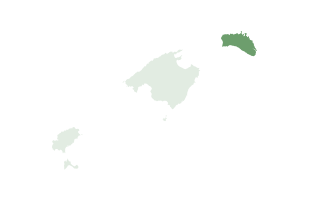
Menorca


