


- Home
- EXPERIENCES
- STORIES AND FEATURES
- "THE GOAL OF 25% GREEN BY 2030 IS WITHIN REACH IN THE BALEARICS"
"The goal of 25% green by 2030 is within reach in the Balearics"
 REPORT
 REPORT
 REPORT
 REPORT
 REPORT
 REPORT
Jeroni Vera, technical director of the CBPAE, backs a realistic sustainable farming model
Jeroni Vera is technical director of the Balearic Council for Organic Farming (CBPAE), the body in charge of certifying that organic products from the Balearic Islands comply with strict EU regulations. With a background in biology and a pragmatic outlook, he’s been at the helm of an increasingly popular system for more than a decade. Today, organic production takes up more than 21% of utilised agricultural area on the archipelago, with notable gains on islands like Menorca and Formentera. Vera is committed to sustainable, supported growth: less bureaucracy, more training, better communication and greater recognition of the hard work put in by organic producers.
What got you interested in organic farming?
My interest was piqued during my biology studies, when I started leaning towards the environmental branch. I chose Organic Farming as an optional subject with Jaume Vadell, who was the one who introduced me to this world. Then I started working with him in that department, and I realised the values of this type of farming—respect for the environment, for animals and for people—matched what I was looking for in my career. It was a natural path that led me to where I am today.
What makes this model different from the conventional model?
Organic farming is regulated by an EU regulation that governs how food must be produced and controlled. It’s a system that seeks to be respectful of the natural environment, wildlife, farm animals and farmers’ health. It also produces healthier, more sustainable food. It’s a way of understanding the countryside based on a commitment to the present and the future.
How did you become technical director of the CBPAE?
I started as an inspector, visiting farms, industries and businesses to ensure they complied with organic standards. In 2010, due to financial issues, the team was drastically reduced and we were left with a minimal structure. I then took on the position of technical director, which I still hold, and now I coordinate inspections, manage the inspection staff and also take care of the financial and promotional side of the CBPAE.
How has the organic industry evolved on the Balearic Islands?
Organic production has been the fastest growing farming sector in recent years, even in times of crisis. Both the number of hectares and the number of providers is increasing every year: today there are more than 1,300 of us, including farmers, processors and traders, and we now have more than 50,000 certified hectares, representing more than 21% of utilised agricultural area on the islands.
Which crops are leading this organic transformation?
Mallorca is dominated by mixed crops of cereals, legumes and nuts, which are mainly used to feed sheep. In Menorca, the model is based on large farms with their own organic cattle and pastureland. But the crops that have grown most in recent years are olives and grapevines. With regard to wine, more than 50% of Balearic vineyard surface area is already organic, partly due to the decent uptake of these products among consumers.
What role do Menorca and Formentera play?
Menorca has recorded an increase of more than 1,000 hectares of organic land in a single year, meaning it has already reached the 25% EU target of utilised agricultural area set for 2030. Formentera, despite its size, has also grown and is nearing 400 hectares. There, the local farming cooperative, Cooperativa del Camp, jointly manages the plots of all its members and is registered in organic production, meaning all plots are organic.
What are the main challenges for producers who want to go organic?
The first is climate change, which affects all farmers, whether organic or not. Organic farming uses local varieties and techniques that are better adapted to the environment, but drought, excessive heat and lack of cold complicate many crops. Another major challenge is bureaucracy. The steps to become certified are complex, especially for small producers. We’re not asking to get rid of them—because many of them are EU requirements—but we are asking for support for producers to be able to meet them without taking away from their time in the field.
Do you think complex administrative procedures hold back new producers?
Yes, especially the smallest ones. Many don’t have the resources to deal with the bureaucracy side of things, and this deters them. Technical support should be made available so they can focus on their core business: sustainable farming. In the end, we all benefit from a farming model that looks after the land and our health.
How much is climate change affecting the Balearic countryside?
Very much so. Not only because of the lack of water—which is already a structural problem—but also because of rising temperatures. There are crops that need cold weather to flower properly or to stave off certain pests. If we don't get that cold weather, the cycle is disrupted. Moreover, water is scarce and we compete against tourism and residential use, further reducing availability for the countryside.
What can be done to boost the visibility of local organic products?
We need greater communication. Consumers are aware, but many still don’t know what’s behind the organic label. Added to this are new labels—’sustainable’, ‘regenerative’, ‘animal welfare’—which can be confusing, as many have no real certification behind them. A clear distinction must be made between which products are regulated, such as organic products, and which are not. This requires clear, coherent campaigns from government bodies and organisations such as the CBPAE.
What role do organic local products play in Balearic culinary culture?
They’re essential. People want to recover flavours from their grandparents’ times, from traditional products. If these products are also grown without chemicals in an environmentally-friendly way, even better. It’s a way of connecting with the cultural identity of the islands.
Is it fair to say that organic is also the most sustainable?
Yes, they go hand in hand. Organic farming is based on sustainability: it uses fewer resources, takes care of the soil and respects natural cycles. The term ‘sustainable’ is used a lot, but there’s not always a real practice behind it. In terms of being organic, there’s a regulated, verifiable system.
Do you think the Balearic Islands will reach 25% organic by 2030?
Yes, even earlier. Menorca has already reached it, Formentera too. Mallorca, which has the largest surface area, is at 21%. Based on the trend over the last five years, it’s very likely that we’ll exceed the target before the deadline.
What measures do you see as key to entrenching the organic model?
Reduce the bureaucracy involved and improve traceability. There are some producers who grow organically, but their products don’t reach the consumer with this label. This needs to be addressed. We also need more investment in promotion, vocational training, research and communication. The Conselleria has announced a strategic plan for the next four years. If the right action is taken, it’ll be possible to reinforce what has been achieved and continue to grow securely.
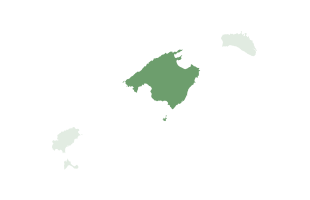
Mallorca


