



- Home
- EXPERIENCES
- STORIES AND FEATURES
- "WE CAN’T DO GREEN AGRICULTURE IN THE RED"
"We can’t do green agriculture in the red"
 REPORT
 REPORT
 REPORT
 REPORT
 REPORT
 REPORT
Minister Joan Simonet advocates for a primary sector adapted to the present, forward-looking and, above all, profitable.
Joan Simonet (Alaró, 1971) is an agricultural engineer and current Minister of Agriculture, Fisheries and Natural Environment for the Balearic Government. With a career linked to both farming associations and public management, he’s worked both inside and outside the primary sector. He was mayor of his home municipality and for years led ASAJA Baleares (Young Farmers’ Agricultural Association of the Balearic Islands). Today, within the Regional Ministry, he seeks to take the long-standing grievances of the countryside and turn them into effective measures to support the future of the island’s farmers.
What’s it been like to go from representing the sector from ASAJA to now heading the Ministry?
I don’t consider myself a farmer in the strict sense of the word, because I’ve never directly made a living from farming. But as an agricultural engineer, since I finished my degree, I’ve been linked to the world of farming in the Balearic Islands for more than 25 years, both in private companies and in government. Moving to the Regional Ministry has meant a change of role, from being on one side of the table to being on the other, but with lots of projects that we already had underway together. In short, I knew what I was getting into.
How would you describe the current state of the primary sector in the Balearic Islands?
It’s a minority sector, under pressure from other economic sectors and deeply affected by the island context. There are many constraints: access to water, land, the market... Everything is more difficult. But there are also opportunities, such as the value of local produce or direct sales. Industries such as wine, oil and the processing of certain livestock are doing well. Not everything is negative.
The next generation is a constant concern for the sector. What’s the situation here?
It’s true that the average age is high, but there are also young people getting involved. Every year we manage about 100 new recruits with specific support, and we’ve seen that 30% of them continue after five or six years. That’s a high rate compared to the rest of the country. Many are joining family farms or opting for new models: organic farming, processing, direct sales... It’s also true that the number of farms is going down, but those that remain are increasing in size, which is a general change in the dynamics of Spanish and European farming. I am optimistic.
How can we encourage those who don’t come from rural families to see this as a career opportunity?
The first thing is to stop the constant stream of negative messages about the primary sector, as this is the worst way to encourage young people to enter the sector. Although there’s work to be done, there are successful experiences and they need to be made visible. We’re also working on measures such as tax relief, priority support for young people, and streamlining payments. Local products, if well promoted, can be a source of profitability. The countryside must be made attractive by highlighting its real potential.
Which sub-sectors are strongest and which need more support?
Wine is now the most cutting-edge, having made great progress in the last 20 years. Then there’s oil and some examples of making cheese by processing milk, both in Menorca and Mallorca. In Ibiza, seasonal water-based farms work well. On the other hand, extensive livestock farming is the most complicated sector. It’s very much affected by the weather, for example when it comes to grains and pastures, and a bad year can be highly damaging. As far as nuts are concerned, rainfed almond trees have also suffered from Xylella disease in recent years. On the other hand, crops such as carob have potential if prices are stabilised. And let’s not forget small yet key sectors such as beekeeping. Other crops such as figs and other types of fruit trees could have a lot of potential if they’re adapted to new climate insights, but a lot of work would have to be done; we’re still a long way behind.
What are the Ministry’s main objectives?
Above all, profitability. Farms must be viable. All policies should be aimed at allowing farmers to pay their bills and live a dignified life. This includes support, promotion, digitalisation, investment and sustainability. It’s a cost-effective and environmentally friendly vision, but we can’t do green agriculture in the red.
What role do training and innovation play in this model?
A key role. Training shouldn’t just focus on farming techniques, but also on financial management, taxation, workplace health and safety, etc. It must always be aimed at boosting profitability and also be available to everyone: farmers, semi-skilled workers and new professionals. Universities need to connect with the reality of the countryside and the Common Agricultural Policy, which sets our rules.
What’s being done in terms of water and irrigation in the face of climate change?
We’re working on two areas: improving the efficiency of well water use and increasing the use of treated water. The latter is complex because it involves lengthy administrative and environmental formalities. And we also have a problem with the salinity of this water, as it can’t be used for irrigation and has to go back into the sea. But this is a key issue, as water-based farming offers very good numbers in terms of profitability. This is one of our priorities.
What importance does local produce have for the Balearic Government?
A great deal. 'Local produce’ is defined by law: only that which comes from the Balearic countryside, either directly or processed, is local produce. The fact we have native breeds and local varieties is also an added benefit. It needs to be promoted both on and outside of the islands. We must take advantage of the fact that tourism is a direct export channel here. We’re committed to ensuring that locals value our produce, and that tourists discover it at the source. This is a huge added benefit.
How can tourism directly benefit farmers?
Through measures such as complying with the Balearic circular economy law, which obliges hotels to buy at least 3% local produce. Moreover, by encouraging complementary activities: direct sales, tastings, visits to farms... This allows direct farmer-visitor contact. Tourism should be an opportunity for the primary sector.
How do you see the future of the primary sector and what would you like to achieve during this term of office?
I am optimistic. There are projects that work, new investments and viable initiatives. Of course, you have to adapt to change: not everything that worked 50 years ago works today. But there’s still some way to go. My goal is to boost profitability, so that farmers not only live well, but can even improve, invest, grow and adapt to the market.
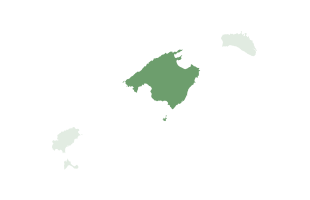
Mallorca


