



- Home
- EXPERIENCES
- STORIES AND FEATURES
- ‘THE MORE BEES I HAVE AROUND ME, THE SAFER I FEEL’
‘The more bees I have around me, the safer I feel’
 REPORT
 REPORT
 REPORT
 REPORT
 REPORT
 REPORT
Vicent Marí, president of DOP Mel d’Eivissa, explains the unique qualities of this product.
Vicent Marí has an impressive academic CV. He’s currently finishing his studies in Political Science, his seventh degree. His insatiable curiosity has led him to learn in-depth about the complex world of bees, priceless suppliers of one of Ibiza’s most outstanding food products: honey.
What does Mel d’Eivissa taste like?
Ibiza is an exceptional place for beekeeping. It’s home to flowers that don’t grow anywhere else in Spain. Since it rains very little, the plants are more aromatic, and that comes through in the smell and taste of our honey. It’s different to other high-quality honeys because Ibizan honey has a stronger aroma. That’s the distinguishing factor.
What does it mean to have the DOP Mel d’Eivissa seal?
First of all, it’s a mark of quality that distinguishes us. Its specific character is linked to the island’s unique flora. Secondly, it’s a huge honour and responsibility. Just think, it’s the first DOP for honey in the Balearic Islands and the seventh in Spain. This certification not only protects local producers, but also promotes the product both nationally and internationally.
How would you convince a consumer to choose Mel d’Eivissa over another honey?
The seal of our DOP means guaranteed quality, freshness and authenticity. While it may be more expensive, it offers a unique experience in terms of flavour and scent. Last year we sold every single product we put out for sale. Customers know how to appreciate a high-quality product.
How many harvests of honey are there per year in Ibiza?
15 years ago, there were three harvests: spring, summer and autumn/winter. The honey in spring is light and clear, and mainly derives from citrus and almond trees. Summer honey, with a darker colour and more viscous texture, comes from plants like thyme. Honey from the autumn/winter season is denser and more aromatic due to carob and heather. The problem is that as there’s no rain, there are no flowers or nectar. With such little food for the bees, we can only carry out one of these three harvests. Bees are like us when our defences are low.
Does drought pose a real problem for hives?
Drought is one of the biggest challenges that we face. The queen bee modulates the eggs she lays according to the temperature, humidity and food available outside. If the temperature outside is very high and there’s no rain, then there’s no food. This means that few eggs are laid by the queen, so that dying bees are not replaced. Recently we’ve lost many hives.
What does beekeeping mean to you?
Beekeeping is a constant learning process. Working with bees is like opening a window to a meticulously organised world. Every time I observe a hive, I’m not just seeing a group of bees, but also a microcosm that works accurately. It’s a showcase of life. It brings me well-being, I feel fulfilled. Hours fly past without me noticing, I simply enjoy the harmony. The more bees I have around me, the safer I feel. A day where they don’t sting me is a day lost.
Where does this passion come from?
Ever since I was little, they captured my attention, these beings know what they have to do, how and when to do it. When I was 25, I started helping my friend Jaume Ferrer with his hives. I only went when I had time to spare, but no more than that. For work and family reasons, I couldn’t give them the time they require. Think of it not like having a pair of canaries; you need a site and training. Finally, Jaume gave me two hives in 2012. From there I started to take it seriously until I reached the 200 hives I have today.
Are 200 hives enough to make a living from beekeeping?
Not at all. Although I market the honey they produce as Mel de Can Marí, what I make is only a small financial amount. To be able to live off it, I’d need a lot more. Beekeeping, for me, is essentially a hobby.
In your case we’re talking about passion and knowledge. How many books have you published on the world of bees?
I’m currently writing the seventh. I’ve written Lèxic apícola eivissenc, La Miel de Ibiza, Las Abejas y Las Flores, etc. I know something, but the truth is that it’s the bees who are teaching me new things every day, and I just express them in books.
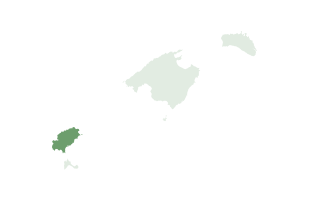
Ibiza


