



- Home
- EXPERIENCES
- STORIES AND FEATURES
- ‘THE BEST PRODUCE IN THE WORLD IS MENORCAN. THERE’S SOMETHING UNIQUE ABOUT IT WHICH MAKES IT INCOMPARABLE’
‘The best produce in the world is Menorcan. There’s something unique about it which makes it incomparable’
 REPORT
 REPORT
 REPORT
 REPORT
 REPORT
 REPORT
Pau Sintes won the European Young Chef Award in 2022. His dishes are a true celebration of the spirit of Menorca.
Pau Sintes is the head chef at Cristine Bedfor in Maó. From there, he is strongly committed to a direct relationship with a wide variety of local producers. He believes that this is the best way to provide quality and authenticity. Passion for local produce and Menorcan cuisine shines throughout his meaningful discourse.
Pau, where did your passion for cooking come from?
When I was a child, I used to pick the vegetables and tubers in the family garden that my father didn’t pick because they were too small. I loved making recipes with them. I remember writing them down in my mother’s recipe book, giving them names like ‘garden medley’. I also loved watching my mother and grandmother cook. My grandmother had one of the few stoves that existed in Alaior. Some of the many things they made were pastissets (sugar cookies) and amargos (almond biscuits). People would also go there to cook their casseroles, and it became a very special community meeting point. All this influenced me a lot, you might say that it fuelled a real passion for cooking.
One of the restaurants you trained at is Celler de Can Roca. There, you won the yearly competition that the stagiaires (chefs in training) take part in. How did you do it?
Each chef presented a dish. I presented one with leeks, a basic ingredient often used as a base in broths and sauces, but not as a leading ingredient. I created thirteen different preparations of this product using age-old techniques that, for me, are the basis of everything. It was so rewarding to win that competition.
With such a promising career, you are sure to have received many job offers. And yet you have always known that you wanted to work in your home, Menorca. Why?
My cooking is highly Menorcan in nature, strongly tied to the produce of the island. At the restaurant, we have gone from having five suppliers to nearly thirty, each one specialising in local products, such as salt from Fornells, cheese from Santa Catalina or butter from Sa Canova. I believe it is essential to spotlight the produce of Menorca and to support local producers. While I appreciate my training elsewhere, my place is in Menorca, where I can create and develop my cooking in line with my culinary identity.
How would you define the produce of Menorca?
In my opinion, it is the best in the world. The quality and flavour of the ingredients from here are incomparable. Maybe it’s the unique island environment, surrounded by a sea that salinizes everything, that makes the flavours more intense and special. Cooking with these products fills me with pride. I love going to the farms, talking to the farmers and understanding the philosophy behind their work, which is consistent with ours. This direct contact enables me to offer authentic, high-quality dishes at the restaurant.
How would you describe Menorcan cuisine and your approach to it?
Menorcan cuisine is highly seasonal and creative. There are numerous recipes for each seasonal product. For example, during asparagus season, we can find a number of ways of preparing this ingredient. That was also my experience at home. During courgette season, we were constantly eating different courgette dishes. My approach follows this tradition, always showing respect for the product and using techniques that highlight it without covering it up. That does not mean shying away from innovation. Some new techniques show more respect for the product than certain old ones. We should not fear the Avant Garde. My aim is for each dish to have a leading ingredient, complemented by other products in the best way possible.
How do you cope with the frenetic pace of the kitchen?
The kitchen is a high-stress environment, but planning and organisation are key factors in managing it. By having everything properly organised, there is time for creativity, which is essential in keeping up motivation and quality. It is important to find a balance between efficiency and innovation, always ensuring that each dish comes out perfectly and that the team is motivated and focused.
What did it mean for you to win the European Young Chef Award?
It changed my life. It prompted a media explosion that I tried to manage as well as possible. Besides, I was representing Menorca in the competition and I wanted to defend its cuisine. There was a long history behind the stuffed aubergine we presented because it represented different producers and products. We could have gone with a lobster stew but that wonderful dish doesn’t symbolise everyday cooking. Seeing how proud people felt and how they identified with my achievement was the most gratifying part. It was not just a personal award but also a tribute to the island and its producers.
What is your favourite dish and made by whom?
The stuffed courgettes made by my grandmother are unbeatable. They are simple but full of flavour and memories. She makes them with sautéed vegetables and a bit of egg, using the courgette itself as the container. My mother makes them quite well too, but my grandmother’s have a special flavour I’ve never found anywhere else. They are a reflection of Menorcan cuisine at its very best.
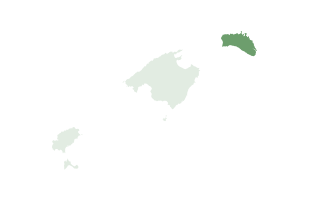
Menorca


