



- Home
- EXPERIENCES
- STORIES AND FEATURES
- "WE HARVEST SALT AS WE DID 2,000 YEARS AGO: BY HAND, IN THE SUN AND WITH RESPECT FOR THE ENVIRONMENT"
"We harvest salt as we did 2,000 years ago: by hand, in the sun and with respect for the environment"
 REPORT
 REPORT
 REPORT
 REPORT
 REPORT
 REPORT
Flor de Sal d'Es Trenc combines tradition, the environment and excellence to create a unique salt.
Toni Gutmeyer is the head of Flor de Sal d'Es Trenc, a company founded in 2003 that has turned hand-harvested salt from the Es Trenc salt flats into an internationally renowned ingredient. Tradition, the natural environment and sustainability come together in this project that has brought the taste of Mallorca to 18 countries.
How was the Flor de Sal d'Es Trenc project born?
Its origins can be traced back to the history of the salt mines, where operations resumed in 1958. Although there had always been salt makers in the area, it was only then that it started being used for systematic sea salt production. Around 22 years ago, the decision was taken to go one step further: to start manually collecting the top layer of saline water–the so-called ‘flor de sal’. It's a very laborious and delicate process, carried out by only a handful of salt mines in the world. We do it the way it was done thousands of years ago, and that makes us completely different.
What distinguishes you from other brands of sea salt?
Mainly the artisanal way of harvesting. Our flor de sal is entirely hand-harvested, sun-dried and organic. We're also IFS certified, the highest quality standard for food in Europe. This attention to detail has led us to receive important awards. In 2013 and again in 2023, the renowned German organisation Stiftung Warentest ranked us as the best sea salt on the market, which was a game changer for us in countries like Germany.
What role does the natural environment play in your work?
It's fundamental. We're based in a protected natural park, and not only do our salt mines avoid damaging the environment, but they actually enrich it. The salt flats create unique habitats for many native birds and species. Our activity is one of the few industrial activities that generates biodiversity. Here, we work with people who are very committed to this model. It's a part of our DNA and unique selling point to the world.
How is your salt used in Mallorca's cuisine?
Salt is an essential part of all culinary cultures, and the Balearics are no exception. Lots of people remember collecting salt from the cocós (rock pools) with their grandparents or parents. We've maintained this link with tradition, but also with contemporary cuisine. We collaborate with chefs and restaurants all over the island. We attend food events such as the Sardine Festival, where we provide our salt to all the stalls. Additionally, we offer everything from the most basic salt to gourmet Flor de Sal, as well as flavoured salts that enhance specific dishes.
How did the idea of creating flavoured salts come about?
It was a proposal from our colleague Laura Calvo together with several Mallorcan chefs. We wanted to create a salt where herbs were complementary, rather than the focus. We mixed salt with local herbs and spices in balanced proportions, and varieties such as Mediterranean and black olive emerged. These products have been very successful, both in shops and among chefs. And we continue to work on new ideas with their help.
Why continue to harvest flor de sal by hand in an era of automation?
Because it's a part of who we are. Our work makes no sense without this artisanal component. Sun-drying and hand-harvesting are key to the quality of the product and the value our customers perceive. When someone sees the process in person, with ten to twelve salt farmers working every day with care and patience, they understand perfectly why the price is so high. In a world where everything is moving fast, preserving these methods is what gives us meaning and makes us stand out.
Sustainability is another cornerstone of yours. How do you apply it on a day-to-day basis?
We've been committed to sustainability for years. We've banned plastic bottles on tours and use 100% recyclable or compostable packaging. We also work with local projects, such as Cleanwave’s restoration of posidonia seagrass in Porto Colom, and plastic-free festivals. Our commitment to the environment is real, not only because of our philosophy, but also because our production depends directly on it. That's why we take the utmost care of it.
How has the gourmet salt market evolved and what future do you see for it?
Salt, once a precious commodity, lost value with industrialisation. Today people are once again looking for quality, sustainable processes and products with their own identity. This is where gourmet salt is gaining ground. There's a real interest in craftsmanship and ecology. I think the market is going to polarise: on the one hand, very cheap salts with no real added benefits, and on the other, products like ours that are committed to excellence. That'll be our space. And we'll put the same care into it as we have so far: by hand, in the sun and with our soul in every crystal.
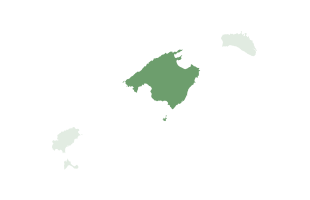
Mallorca


