



- Home
- EXPERIENCES
- STORIES AND FEATURES
- RAISING LAMBS IN CALVIÀ: TRADITION, DEDICATION AND SUSTAINABILITY IN THE FACE OF TOURISM
Raising Lambs in Calvià: Tradition, Dedication and Sustainability in the Face of Tourism
 REPORT
 REPORT
 REPORT
 REPORT
 REPORT
 REPORT
Antoni Bonafé backs local products and extensive livestock farming in Mallorca.
Antoni Bonafé Ramis (Calvià, 1971) is a third-generation farmer and stockbreeder. Raised on Ses Planes farm, he’s dedicated his life to the land and livestock, focusing on sustainable production and local products in an environment dominated by tourism. From sheep farming to growing nuts, Bonafé stands for active, professional and valuable farming in Mallorca.
How did you get started in the countryside?
I was born in the countryside, literally. I am the third generation of my family to work in agriculture and sheep farming. Since I was a child I’ve lived with livestock, and learned the trade by watching my elders work. My beginnings were among animals, fodder and farmland. For me, the countryside is something that runs through my veins.
Did you always know you wanted to dedicate yourself to this life?
Yes, I had other opportunities at the time, but I always ruled them out very quickly. From a young age I felt naturally drawn to the rural world, to animals, to cultivating the land. I never had any doubts about my calling. It was clear to me that I wanted to make a living out of this and I’ve worked with that in mind all my life. It hasn’t been easy, but I can’t imagine doing anything else.
How is your farm currently organised?
Our farm is mainly based on sheep farming for meat. We also grow typical Mallorcan produce such as almonds and carob. We also plant fodder and grain to feed the livestock. It’s a mixed farm with a fairly traditional approach, but we always aim for a balance between productivity and sustainability, making good use of available resources.
How do you combine tradition and innovation in the countryside today?
These days, you’ve got to adapt to changing times. We now use technology such as GLS for livestock and self-driving machinery for more efficient sowing. It was difficult at first, but it’s a much appreciated help. Of course, without forgetting tradition. Our grandparents’ expertise has taught us things that machines cannot. It’s a complement, not a replacement.
How important are these traditional practices?
They’re essential. Our elders didn’t have access to technology, but they faced the same problems as we do and knew how to read the countryside like no one else. This built-up knowledge is so valuable. It means you’re prepared for any problems and better understand the environment. Maintaining these practices is not just a cultural issue, but also a practical one. Combining them with existing tools greatly improves farm management.
What’s it like to raise sheep in Mallorca today?
Raising sheep here is becoming increasingly difficult. Sheep farming requires commitment and determination. It’s a highly demanding 24-hour job. Climate change is also affecting us with long droughts that make grazing difficult. It’s a profession that only those who really feel it’s their way of life can put up with. Lots of farms are disappearing due to lack of changeover and adverse conditions.
How’s the market looking for Mallorcan lamb at the moment?
Selling lamb has never been a problem in terms of output. Price has always been the challenge, which was well below what it should be for years. Fortunately, prices have now improved and it’s possible to work with a little more stability. Mallorcan lamb is fresh and can’t be stored like crops, so it must be moved quickly.
Are people eating less lamb than before?
Yes, every year we notice a drop in consumption, both locally and nationally. Cooking at home is becoming less common, people want quick dishes, but lamb takes time to prepare. It’s become something eaten more in restaurants than at home. It’s only served on specific dates or in traditional recipes such as empanadas.
What’s needed to ensure quality lamb?
Their diet is everything. Our animals graze in fields with grass, legumes and wild herbs, which results in tasty meat with its own identity. Monitoring their health is also key to ensure that it reaches the consumer as it should. After all, we’re talking about a food product and safety is just as important as flavour.
What about sustainability? What measures do you apply?
The extensive livestock farming we practice is a form of sustainability in itself. Our sheep help keep fields clean, prevent fires and maintain a balanced ecosystem. Unlike other more intensive models, we work in harmony with the land. We’re committed to practices that respect the environment and support rural identity.
Why’s it important to back local products?
Because consumers need to know what they eat and where it comes from. Backing local products is not just about eating fresh and local, it’s also about supporting farmers and stockbreeders who maintain the landscape, traditions and rural economy. It’s a way of protecting the land and resisting a globalised model that fails to understand sustainability or identity.
How do you see the future of the Mallorcan countryside?
The main challenge is for young people to see that’s possible to live a dignified life in the countryside. We need farms to be profitable and to be offered realistic conditions from the very beginning. We also have the challenge of climate change, which is forcing us to rethink many things. But if there’s political will, training and commitment, there’s still hope for a vibrant farming landscape adapted to modern times.
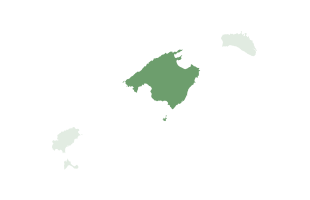
Mallorca


