



- Home
- EXPERIENCES
- STORIES AND FEATURES
- "MALLORCA SHOULD DRINK MORE OF ITS OWN WINE"
"Mallorca should drink more of its own wine"
 REPORT
 REPORT
 REPORT
 REPORT
 REPORT
 REPORT
Pere Calafat defends organic farming and local wine as the backbone of the countryside’s future.
Pere Calafat Vich, a farmer and winemaker from Santa Maria del Camí, has run Jaume de Puntiró winery since the 1990s, where he grows organic vines to make wine using local grape varieties. Heir to traditional wisdom passed down through his family, Calafat stands for farming with close ties to the local land, is critical of globalisation and committed to sustainability.
How did you get started in the countryside?
I started very young, following in the footsteps of my father and grandfather, who worked in grape growing and winemaking. At the age of 23, I decided to work full time in the countryside and take up the profession of grape growing. The transition was natural, a learning process that enabled me to take their experience and turn it into my craft.
What values did you inherit from your family in your way of working the land?
I grew up in a farming family. Although I wasn’t the best student, I saw the countryside as the place to develop myself. Over time, I came to understand the value of the traditional wisdom passed down to me by my parents and grandparents. When I was young I didn’t fully appreciate it, but over the years I’ve come to understand the depth of this ancient knowledge. You realise there’s great wisdom in their practices and advice. Today I’m truly grateful for that legacy.
How has vineyard management evolved since then?
The basic techniques are still the same, but everything’s been upgraded with technology and machines: from ploughs to sulphate pumps and winery machinery. But what’s essential is to understand why certain tasks are done, such as ploughing or green pruning. In modern times, this age-old knowledge is sometimes ignored. But during times like last year, when we had a huge drought, we’re reminded of its importance when facing the challenges of today.
You’ve said the vine is one of Mallorca's saviour crops. Why?
When I was a child, almonds were the dominant crop. Today, its importance has dwindled and vineyards have gained ground. They’ve become a safe option for farmers, but also an attractive investment for outsiders. This has led to more hectares planted and more wineries. Although some say we’ve already reached the peak, I believe there’s still some way to go. The main challenge is marketing.
How can marketing be improved?
Local consumption of Mallorcan wine is very low. Out of every 100 bottles opened on the island, only 15 or 16 are from here. We should convince tourists to try local wine as part of their holiday experience. A well thought-out institutional campaign is needed. So far, resources have been invested without any real results. If we reached 40 out of every 100 bottles being Mallorcan, the marketing problem would be solved.
Why do you focus on local varieties at your winery?
We grow Manto Negro, Callet, Prensal Blanc and Giró Ros. These varieties are very well adapted to the climate and allow us to make warm Mediterranean wines that stand out. Competing with international varieties such as Syrah or Cabernet is more difficult, because we’re dealing with wines from countries with a lot of tradition and large-scale production. But supporting what’s ours means supporting the identity and uniqueness of Mallorcan wine.
Do you think enough has been done to define and promote local products?
For the time being, we’ve not even defined what ‘local product’ means. Is it just something made here? Or is it also the ingredients in it? Should it be made from certain varieties? This is an ongoing debate. Only when this is resolved will we be able to effectively promote local and zero-mile products. Right now, there’s a lot of confusion and a lack of clear strategy.
What challenges do winegrowers in Mallorca face today?
The challenges are immense. From the lack of manpower to the impact of climate change, which is making winegrowing increasingly difficult. On top of that, we must continue working meticulously and efficiently every day. We face a difficult reality.
What role does organic farming play at your vineyard?
We’ve been organic since the 1990s. At first we did it because of our beliefs, but today it’s also because it’s more convenient. Customers increasingly value healthy and natural food. We’ve proven that it’s possible. You don't have to be a magician to make quality organic wine: you can do it through knowledge, dedication and respect for the environment.
You’re involved in projects such as "Mallorca en Fruit". What do these initiatives bring to the table?
Yes, we’ve been involved for two years. These are projects promoted by bodies such as the Association of Organic Farming in Mallorca (APAEMA), allowing us to plant native trees such as olive and carob trees. We receive financial and technical support, which makes it easier for us to diversify our crops. This type of initiative gives meaning to farming that’s connected to the land and biodiversity.
Why is it so important to defend local products in the face of globalisation?
Globalisation has thrown us off track. Our children no longer know what fruit is in season, what to eat, what’s healthy. If we don't do something, we’ll end up losing fresh food and move on to only eating pre-cooked products. There are some extreme examples, such as packaged fried eggs. To back local products is to preserve food culture and health.
Do you think the support currently available is effective?
There’s been support, but it’s often proven ineffective. Investments have been made, but with very little results. We need better thought-out, smarter campaigns that really reach people. It’s not easy, but it’s essential if we’re to make progress.
How do you see the future of the Balearic countryside?
The main challenge is generational change. There’s also climate change. Some of the support for young people is working, which is a good thing. For climate adaptation, the solution may lie in native varieties, which are better suited to harsher conditions. We must make use of what’s right in front of us.
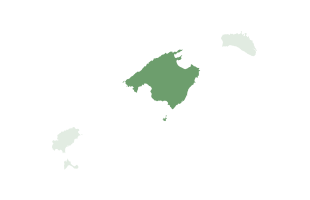
Mallorca


