



- Home
- EXPERIENCES
- STORIES AND FEATURES
- "I’D STILL CHOOSE TO WORK THE LAND: THIS TRADE HAS GIVEN ME A FULL LIFE"
"I’d still choose to work the land: this trade has given me a full life"
 REPORT
 REPORT
 REPORT
 REPORT
 REPORT
 REPORT
Xesc Sans, an organic farmer in Calvià, grows crops based on wisdom and awareness.
Xesc Sans is one of the most committed voices to defend organic farming in Mallorca. In Calvià, he mainly grows carob, almond and olive trees using sustainable techniques. As the first in his area to be certified as an organic producer in 1999, he combines experience, farming activism and a firm commitment to local produce and the traditional landscape.
What was your earliest experience of the world of farming like?
My earliest memories of farming are from when I would play games and pick fruit. I was born at Ca'n Ros, in Calvià, and from an early age I loved collecting almonds and carob, although I was often told to wait for the grown-ups. When I was six or seven years old, I already had this curolla (ambition). Later on, I started secondary education and did voluntary military service, but my path was clear: to devote myself entirely to my family’s farms.
Did you always know that you wanted to go into farming?
When I started, in the mid-1980s, working the land was frowned upon. Even in my family environment there were doubts: my father suggested alternatives to me, because he himself was never a full-time farmer. But when he saw how involved I was, he understood that it was my calling. Also, working the family farms ourselves meant we could avoid relying on third parties to maintain them. I started learning alongside my father’s employee, and when he retired, I took on all the tasks. Now I only resort to help occasionally if the harvest requires it.
How much did your environment influence your current farming knowledge?
Very much so. I learned from my elders, true masters of the land. One of them was Damià from Son Bornet, who taught me how to graft carob trees, a technique I still use today. I also learned from Mestre Perico from Son Roca, who taught me the basics of dry stone, which is vital for maintaining farmland borders. Then I also trained with students from the margers school. I apply this wisdom every year, when I repair stone walls, barriers or structures. I still find it to be creative, useful and very rewarding work.
What kind of crops do you currently grow on your farms?
I work on dry land, as is the standard in Calvià. I mainly have carob, almond and olive trees. Although almond trees used to be the main crop, today they’re no longer viable on dry land due to diseases and climate-related changes. I’ve been replacing them with carob trees, which are hardier and resistant. The olive trees I have are centuries-old Mallorcan trees, grafted on ullastre (wild olive) trees for reinforcement. Although production is irregular, they’re very agreeable trees, easy to maintain and very well adapted to our terrain.
How do you include livestock in your farming system?
I have sheep, but I don’t keep them for livestock purposes. I have them because they help me to maintain the farm naturally. In winter they eat olive cuttings, in summer they eat shoots from the ullastre trees, and they also feed on the olives that fall and break open, which also helps to control olive fly. That’s why I don't consider myself a livestock farmer as such, but a pagès (Balearic countryside worker). And I’m convinced that the land performs better with animals, in a more balanced and sustainable way.
Why did you decide to switch to organic farming?
I became certified in 1999, mainly as a matter of principle. Those who work the land are the first consumers of what they grow, and also the ones who handle chemical products if used. I didn’t want to expose myself or my environment to that. I also know of no produce that is cleaner or of higher quality than organic produce. It was an important change, not just because we stopped using pesticides, but also because we stopped ploughing the land to prevent erosion. On a sloping farm, ploughing causes runoff, loss of fertile soil and requires you to pick up stones. This change has meant I can better protect the terrain.
What other differences are there between conventional and organic farming?
Conventional farming obtains more production with chemical fertilisers if there’s enough rainfall, but has financial and environmental costs. I prefer to occasionally make use of sheep manure, which enriches the soil for a few years. I cover it with straw to prevent nitrogen loss. It’s more labour-intensive because it’s done by hand, but it’s more sustainable. I have 14 hectares under cultivation, and since it’s my full-time job, I can take care of every detail. That, for me, makes all the difference.
Which crops are currently the most important on your farm?
Carob is now the most important crop, both in terms of quantity and future potential. When I started in the 1980s, almond trees dominated, but over time and given today’s conditions, it’s no longer viable. As well as carob trees, which I plant from seed with my own seedlings, I’ve also been adding more olive trees. All of them are grafted on wild olive trees that grow naturally, which gives them hardiness and resistance. This means the trees are better adapted to the terrain and climate.
How do you see the current situation of carob?
Carob experienced a spectacular boom in 2021 and 2022, with prices up to €2.15/kg. It was crazy, especially compared to fruit like apples or bananas that take a lot more work. It’s a low-cost durable crop, and although the price has now dropped to around 60 cents, it’s still profitable if you don’t pay external labour costs. Also, carob falls by itself if not harvested, meaning animals can eat it. It can’t be machine-harvested like almonds can, but it’s still an agreeable tree with a lot of potential.
You've also restored old water collection systems. What are they?
On the Ca'n Ros estate, where I live, in 2018-2019 I restored a rainwater harvesting system that was formerly used for an oil mill. It’s a traditional mechanism with gravity-fed cisterns, which now means I can water the orange trees without electricity. I restored everything with lime mortar, thanks to a grant from the Serra de Tramuntana Consortium. Beyond being valuable heritage, it’s an example of efficiency and sustainability. Now, it’s so pleasing to see how the water runs after it rains, and to be able to use it as they did in the past.
You are an active defender of the countryside. What does farming activism mean to you?
I think it’s essential to explain what we do and the benefits of our work. Not all activism should be complaining; there should also be positive outreach. I make videos, get involved in the Calvià Farmers Association, and promote pride in our trade. If we want to young people to come and work in the countryside, we can’t just show the bad side of things. This lifestyle has given me motivation, meaning and a fulfilled life. If I were to start all over again, I’d still choose to work the land.
What work do you do at the Calvià Livestock and Crop Farmers Association?
There’s 66 of us with a diverse range of profiles. We use a WhatsApp group to share information, support each other and boost morale. Calvià isn’t a municipality associated with agriculture, but there’s real farming activity, both full-time and part-time. This association helps us feel like we’re part of something, united rather than separate, and able to defend our work.
What can be done to boost the value of local produce?
The most important thing is to try it. I’m a member of the Mè Ecològic Cooperative, and for its 10th anniversary, we organised a meal with lamb on my farm. It was delicious. Lots of people say they don't like lamb because they’ve had bad experiences, but an animal that only eats grass offers unique meat. I also sell almonds directly, and I take care of every detail because I know that customers will thank me for it. It may be a little more expensive, of course, but it’s an investment in health, sustainability and the land. If we don't support local produce, we’ll run out of food and resources in a time of crisis.
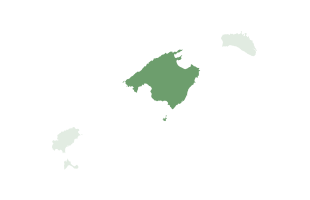
Mallorca


