



- Home
- EXPERIENCES
- STORIES AND FEATURES
- “WE WANT CAROB TO BE IN EVERY PANTRY IN THE BALEARIC ISLANDS”
“We want carob to be in every pantry in the Balearic Islands”
 REPORT
 REPORT
 REPORT
 REPORT
 REPORT
 REPORT
Joana Verger leads the Mallorcan carob revolution from Es Garrover.
Joana Verger is the driving force behind Es Garrover de Mallorca, a company that uses carob to make gourmet products with certified local quality. After leaving a career in the finance industry, she decided to return to her roots and give new life to this fruit traditionally used for animal feed. Today, Joana is one of the main voices backing its nutritional, culinary and cultural value.
What role has carob played in your life since you were a child?
My first memory is the smell. I grew up with carob, literally: the store was under my house. I remember the tractors, the farmers, the damp soil... That smell stayed with me. Now that I've had babies, I've realised those childhood memories are still very much alive.
And what did you learn about the Mallorcan countryside during those years?
Without realising it, I soaked it all in. Our family was a pioneer in the carob industry, with Productos Martín. At the time I didn't appreciate it, but with time this ‘call from the earth’ came and I felt the need to go back and take up what I'd experienced in my childhood. This gave me my drive to honour carob and reintroduce it into cuisine.
Carob used to be considered an animal feed. How did you manage to give it a new image?
Through a lot of perseverance and a great personal investment. Introducing it as a gourmet product in the local market was a huge challenge. Since 2012, I've been fighting to show its nutritional value, its culinary potential and its local origin. Today, chefs and restaurants add it to their dishes like any other quality ingredient. We’ve made a recipe book with chefs from the island, and it's starting to be seen as a product that's ours in the same way as olive oil or almonds.
I heard you had an eye-opening experience in Peru...
Yes, in 2012 I travelled to Piura, in northern Peru, where I saw how they used carob for human consumption. I talked to universities and experts, and saw they were making flour, sauces, drinks, etc. I came back with a suitcase full of ideas and products, and I told my family that we should do something. This is how the brand Es Garrover de Mallorca was born, with a clear commitment to design, packaging and high quality. It was a complete turnaround, an alchemy that turned something seen as ‘rustic’ into something beautiful and healthy.
Do you think there's still untapped potential?
Very much so. Carob from Mallorca is a product yet to be discovered by lots of people. We’ve developed a line of protein with another local company, spreadable creams, sauces, etc., and we're even working on using it in baby food. There are lots of possibilities, and I've specialised in everything from nutrition to product development. We're promoting its use in baby food because it's nutritious and healthy from the early months of life.
And what's your company's current goal?
Our goal is to strengthen the products we already have, such as spreads and flour, and scale up their production. We've also reopened the Carob Museum, which we'd closed during the pandemic, where we offer visits, tastings and explain the whole process, from harvesting to consumption. All this helps to educate people and promote the product.
What properties does carob have that make it special?
It's rich in calcium, magnesium and iron. It's lower in fat than cocoa, contains no stimulants and is suitable for coeliacs. It's a healthy alternative with a personality of its own. It can be stirred into milk as if it were a chocolate drink, but natural. We've even teamed up with JOP to make an ice cream with chocolate chunks, combining flavour with health.
What are your favourite ways to use it in the kitchen?
I love it in sponge cakes, brownies, pizza doughs with xeixa wheat flour, and also as a topping for desserts. We have a sauce that's perfect for meat and fish, like soy sauce, but with its own personality. Carob spreads are perfect for fruit or as a base in sweet recipes. And with the new line of protein powders and bars, we're offering new ways to incorporate it into your daily diet.
What role can carob play in sustainable food production?
It's a product available locally, with a strong history and minimal environmental impact. Since 2015, it's made an appearance at eco fairs and events. Backing it means backing local agriculture, the Mallorcan landscape, and a more conscious food system.
Have you noticed greater interest in organic products in the Balearic Islands?
Yes, there's been a change in mentality. More and more people value local produce, even if it's more expensive. People are willing to pay for something pesticide-free, healthy and sustainable. We want to reach 25% organic surface area in the Balearic Islands and we're on the right track.
What would it take to make carob a staple in any pantry?
Visibility is needed. We strongly rely on social media to share recipes and make it easier for people to incorporate it into their daily lives. I'm also working on boosting production after recently becoming a mother. The more of it we eat, the more we can invest in research and new products. And the most important thing: for people to discover how healthy and versatile it is.
How do you imagine the future of carob and your company in ten years' time?
I see a wider range of products and Es Garrover becoming a leading brand. We want to expand through our online shop and reach countries like Germany or the Nordic countries. Carob has a long way to go, and we're ready to go with it.
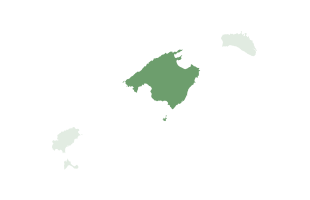
Mallorca


