



- Home
- EXPERIENCES
- LANDSCAPES AND ROUTES
- WHERE OLIVE TREES TOUCH THE SKY
Where Olive Trees Touch the Sky
 LANDSCAPE
 LANDSCAPE
 LANDSCAPE
 LANDSCAPE
 LANDSCAPE
 LANDSCAPE
It's not just olive oil. It's the landscape, it's history... it's Mallorca.
Between mountains that touch the sky and stone walls that tell centuries of history, lies one of Mallorca's most authentic landscapes: the ancient olive groves of the Tramuntana mountains. These trees continue to bear fruit that's transformed into an oil with a Denomination of Origin: ‘Oli de Mallorca’. Olive groves are a living testimony to the island's culture, history and gastronomy. A plant legacy that has nourished people and memories for centuries.
The Mallorcan olive tree has been taking root for centuries on the slopes of the Tramuntana mountains. The rugged terrain prompted the construction of dry-stone terraces which, as well as supporting the landscape, sustain a way of life. The trunks, twisted by time, look like living sculptures: witnesses to the passing of generations who have cultivated their fruit with weathered hands. These trees are more than just crops: they're an identity.
The history of olive growing in Mallorca dates back to pre-Roman times, although it was in the 13th century that olive oil began to be exported on a regular basis. During the 16th century, olive growing became the island's economic driver, and in the 19th century, it came to represent up to 80% of Mallorca's exports. The oil was so prestigious that it was used as a bargaining chip, and references to its quality are found in the writings of Archduke Ludwig Salvator of Austria.
The extra virgin olive oil produced here has its own name: Designation of Origin 'Oli de Mallorca'. It is made from traditional varieties such as Empeltre (also known as Mallorquina), Arbequina and Picual, and its fruity, mild, slightly bitter and spicy flavour is central to the island's recipes. A pamboli (bread with olive oil) without olive oil from this land would make no sense, nor would a Mallorcan table without its trencades olives (split olives), seasoned with fennel, bay leaves and chilli. The Mallorcan olive, in its three forms—green, split green and natural black—has also had a Designation of Origin since 2014.
Beyond its culinary dimension, the olive tree has left its mark on rural language, glosses and customs. Tafones, traditional oil mills that still operate on some estates, were the economic backbone of many properties. Harvesting, which is still done by hand, respects the centuries-old trees and ensures only the best olives are selected. The Mallorcan variety, grafted on the wild ullastre tree, stands out for its spindle-like shape and deep flavour, with a smooth texture and distinct personality.
Mallorca has more than 800,000 olive trees, many of them thousands of years old, maintained by more than a thousand small producers. In the words of Joan Mayol, president of the ‘DO Oli de Mallorca’ label, ‘the strange shapes of these venerable trees, which continue to bear fruit centuries later, make the oil extracted from them rather exceptional’. A plant legacy comparable, he says, to American sequoias or African baobabs. Here, in the heart of the Tramuntana, this liquid gold continues to flow at the calm pace of the countryside.
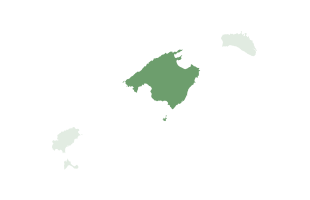
Alaró (Mallorca)


