



- Home
- EXPERIENCES
- STORIES AND FEATURES
- ‘OUR PRODUCTION NEEDS TO RESPECT THE SPACE THAT NATURE PROVIDES’
‘Our production needs to respect the space that nature provides’
 REPORT
 REPORT
 REPORT
 REPORT
 REPORT
 REPORT
Marta Más, together with her father, created Oli Novembre, a project based on organic principles and respect for the environment.
Marta Más quit her job in advertising to delve into the world of olive oil. She says she is convinced that the change was a salvation for her. At their family farm, Son Elsebitx (Petra), they harvest all the olives used to make their product.
In 2008, without any previous experience, you decided to start making your own olive oil, Oli Novembre. How did this adventure start?
My dad was a businessman. When he retired, he told us he wanted to plant a few olive trees at Son Elsebitx. Those few olive trees ended up being 2,500. He did it with the aim of selling olives to other producers of olive oil on the island. When the whole family got together to help with the harvest, we saw something in his face change. He told us he wanted to do something else with the fruit grown on that land. He caught me at a point where I needed a change in my life. I told him I’d go all in with him. I left the advertising company I was working at and we dived into the unknown.
How was the initial stage?
It was a constant learning process, often based on trial and error. We did a lot of courses. We learned a lot from other oil producers who were incredibly generous with us, sharing their knowledge and experience. When it came to selling, my background in marketing helped me to design a bottle, create a sales strategy and set some sales targets.
Your father didn’t have a bad eye when it came to deciding where to plant the olive trees, right?
That’s right. They’re on a south-facing slope and the olive trees get lots of hours of sunshine every day. Also, the Bonany mountain protects us from cold winds. The way they’ve been planted means they get a lot of ventilation. That’s important for preventing leaf spot, a disease caused by a fungus that grows in humid conditions.
Which olive variety do you grow?
We only grow Arbequina and we’re very happy with it. It makes a smooth olive oil that isn’t too spicy or bitter. It sells well in the European market because they’re used to other types of smooth products like sunflower oil or butter. That doesn’t mean to say it lacks character. Our oil has hints of green leaves, grass and tender almonds. It’s fresh and very green, as we harvest green olives.
When do you harvest the olives?
At the end of October to the start of November. On the same day as harvesting, they go to the oil mill. That’s hugely important to prevent the oxidation of the product and the subsequent reduced quality of the oil.
Why did you go down the organic route of production?
Originally, we didn’t, since we had enough on our plate with launching the project. The decision to go organic came years later on my own initiative. I did it because I was convinced that farming shouldn’t be done without the utmost respect for the space that nature provides. It was hard to convince my father. In the beginning I managed to for the financial aspect, but in the end, he’s also seen clearly that, in Mallorca, where the farms are small, it only makes sense to go organic. The island is tiny and we need to look after it. My daughters and all his other grandchildren live here, and we need this land to remain as healthy as possible.
In terms of marketing, you have decided not to sell in supermarkets.
We decided to go for direct sales and small businesses. If I’m putting so much love into a product, I need the person selling it to do it with the same care with which I produce it. Small shops know us well and know what we do, so they’d be able to tell our story. On a supermarket shelf, you’re just an option like any other and you lose a lot of what you’ve put into that oil. We need to really value what we produce and convey who’s behind each product.
How do you convince consumers to buy local products?
It’s the most sustainable and only way of preserving Mallorca’s countryside. The wonderful landscape we have would disappear if farmers disappeared. We need the land to stay as it is, retain water, protect trees to reduce the temperature... If you don’t cultivate or care for the land, the island will become a desert.
What has producing oil done for you?
Leaving the stress of office work behind to physically rest in the countryside was a life-changing experience. It allowed me to find a truer, more satisfying connection with what I was doing. It was my salvation. I came from a world where everything was so abstract, selling ideas and concepts. Moving on to something so practical like watching the olives grow and making oil has given me a new perspective.
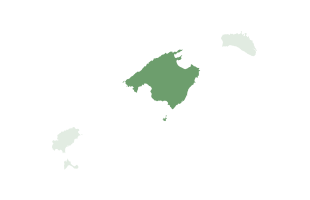
Mallorca


