



- Home
- EXPERIENCES
- STORIES AND FEATURES
- "WE DON’T MESS WITH WHAT WORKS, WE KEEP MAKING COCA LIKE MY GRANDFATHER DID"
"We don’t mess with what works, we keep making coca like my grandfather did"
 REPORT
 REPORT
 REPORT
 REPORT
 REPORT
 REPORT
Can Molinas bakery keeps traditional Mallorcan baking alive.
Miquel Àngel Cañellas is part of the third generation at Can Molinas, a historic bakery in Valldemossa founded in 1920. Along with his predecessors, he’s turned his century-old workshop into a place of pilgrimage for lovers of coca de patata, an iconic Mallorcan potato cake that he continues to knead by hand and bake in a pinewood oven. We chatted with him about tradition, challenges, change and the future.
How did the story of this family bakery begin?
My grandparents, Miquel Cañellas Nadal and Maria Estrades, came from Bunyola in 1920, got married and took over the bakery we know today as Can Molinas. They were the first to light the wood-fired oven we still use today and laid the foundations of a business that was later taken over by my parents, then by my sister and me, which I now run alone more than a century after it opened.
What are your earliest memories of working there?
I literally grew up in the bakery while my parents worked—I helped them. Although at that time everything was very different, we had the same oven and the same shop as now. Over time I learnt each task and progressively took on more responsibilities until I was in charge of Can Molinas, keeping it running on a daily basis.
Did you consider doing something else?
I didn’t think about it; when you’re born into the business, you don’t think about it. I did my studies, but then I continued working here because my parents needed a hand and I liked the work, so I stayed. There was always work here and I’ve stuck with it.
Coca de patata is your token product. What makes it stand out?
In 1920 my grandparents started baking it here, we don’t really know how or why. In the beginning it was big and was cut into pieces; today we sell individual ones but we also make large ones, adding apricots or other fruit. Over time it’s become another symbol of Mallorca, like ensaïmada, which people come here for specifically because we offer the same homemade flavour as it did back then.
Do you follow the original recipe to the letter?
Exactly. Sugar, eggs, butter, flour, oil and the potato that gives it its name. It’s a simple, straightforward recipe. My grandfather taught my father the amounts and ingredients, then my father taught us.
What would you say is the secret of its success a hundred years later?
Don’t mess with what works. At Can Molinas, everything’s done by hand, including rolling the dough and shaping it piece by piece. The machines we have are the same as they were sixty years ago. We produce as much as we can in an artisanal way: on public holidays we can produce a thousand cocas, but we prioritise quality over quantity and want to avoid industrialising the process.
To give us an idea, how many cocas do you sell depending on the season?
In the height of summer, with the rush of tourism, we can reach a thousand units a day; in winter, a couple of hundred are often enough. It all depends on the day, the people, the season, and so on. The crowd changes: in summer, we mostly get visitors who’ve found us in tourism guides, while our local clientele comes more in the cold months to have a coca with chocolate or to find products to take home. Our clientele is diverse.
Have you been tempted to make modern versions?
We still make the ‘normal’ version as usual. For a few years now, we’ve also been filling them with Nutella because people ask for it and children like it a lot. We also make cocas with apricot, peppers, sobrassada... but always with the same dough—that’s non-negotiable. We usually have about five permanent varieties, but if someone orders something specific from us, we’re happy to make it.
You have a century-old wood-fired oven. Does it really offer a different taste?
Absolutely. We load it every morning with pine wood; first we bake bread, then, when the temperature drops, cocas. Although they don’t directly touch the stone, the fiery aroma gives them a special touch that an electric oven can’t provide. It’s less convenient, but it’s part of our identity, as it must be about 100 years old by now.
What’s a day during high season like at Can Molinas?
Now we start at six o’clock to knead the bread, which needs to rest for a few hours. Then we make the savoury cocas, which need a hot oven to cook, Vienna bread and llonguets. Later we make ensaïmadas, which we also prepare every day. At around ten o’clock we prepare the cocas de patata, which need to ferment for twenty-four hours and baked the following day. Between batches, depending on the day, we make other products such as rubiols, crespells and cremadillos.
Your range is very local. Why is it important to keep it going?
We cannot and do not want to compete with industrial baking. As we’re an artisanal bakery, we cannot and do not want to cover everything. Our value comes from offering traditional Mallorcan products, the ones we’ve been making all our lives. Trends come and go, but our essence remains, and people still like Mallorcan products.
What challenges do you face in order for this craft to survive?
Continuing to make all these products is not a problem in itself: the obstacle is labour. It’s hard to find young people willing to learn this trade, which often involves working during public holidays, weekends and hot summers. This isn’t very popular or attractive right now. Schools teach about modern baking, but not traditional products; when someone new comes in, we need about two years to train them and sometimes just when they’ve mastered the trade, they leave.
How do you imagine the next generation of Can Molinas?
My sister has already retired and I, at almost sixty years old, don’t have that much time left at the bakery. We’ll have to hand over the business to the right person, who respects coca de patata and the pastries that have made us famous. Then they can innovate however they want, but I’d like the name Can Molinas to at least stay tied to the tradition that began with my grandparents over a century ago.
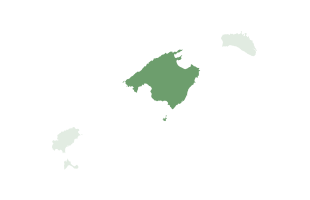
Mallorca


