



- Home
- EXPERIENCES
- STORIES AND FEATURES
- WE BACK NATIVE VARIETIES, THEY’RE AN IMPORTANT PART OF OUR HERITAGE
We back native varieties, they’re an important part of our heritage
 REPORT
 REPORT
 REPORT
 REPORT
 REPORT
 REPORT
Esperanza Nadal, wine expert and director of Vins Nadal, believes a focus on sustainability is essential throughout production.
Esperanza Nadal represents the fourth generation of her family at the head of Vins Nadal, founded in 1932. Since 2002, her work has transformed the company, focusing on the production of new wines and organic grape growing. Having trained in Spain, France and Chile; she is brimming with expertise and passion for an evolving industry.
Question: What does being at the head of a winery with so much history mean to you?
Answer: Being in charge of Vins Nadal is a huge responsibility. It represents the hard work and dedication of the generations that came before me, starting with my great-grandfather in 1932. It’s my responsibility to innovate and bring the winery in line with modern times. Wine is something that has been a part of me since I was little. It comes very naturally to me, I like it.
Question: How would you define the world of wine?
Answer: Wine is culture, identity and heritage. It’s also a product with so much life that is in constant evolution. At the same time, the market also evolves and changes. This means you need to be constantly learning and keep yourself up to date.
Question: Since managing the winery, what are the most significant changes you have introduced?
Answer: We work much more with native varieties. Mainly with Manto Negro which is the flagship of the winery and of the Binnisalem area. Also, with Prensal and Giró. Right now, we’re going through a process of switching vines, going from Cabernet, Merlot and Syrah to Escursac, Esperó de Gall and Vinyater. This means we can produce new wines that we had not made before. It’s about highlighting and preserving our wine heritage.
Question: What weight does tradition hold?
Answer: It holds no weight at all. I don’t need to maintain a balance between one thing and the other. You have to move forward, you have to adapt to the times, while staying authentic. For example, in terms of production, what my grandfather did has nothing to do with what we’re currently doing. What is important is to uphold the winery’s unique identity.
Question: What is your identity?
Answer: It’s based on our history. It’s about keeping the authentic characteristics and the winery just as we found it: environmentally-friendly, respectful of those who live here and of those who visit us looking to escape from mass-produced and standard products.
Question: To what extent is it important to focus on sustainability?
Answer: Our approach is environmentally-friendly as a matter of principle. For this reason, we focus on regenerative viticulture. In this respect, we have moved on to using ground covers, pure animal manure and we plant fruit trees and aromatic plants to support biodiversity. We need to keep the soil alive to wean the plants off their dependence on chemical substances and derivatives. This improves the grapes and the plants’ resistance.
Question: What do DOP Binissalem wines have in common?
Answer: The soil in the area of Binissalem has its own special characteristics. The soils are deep and very rocky. This is all down to being in the foothills of the Tramuntana mountain range. This provides a lot of richness to the land in the area. It adds a unique quality to the wine which is evident in different ways depending on the type of wine and the winery.
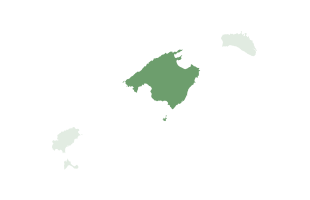
Mallorca


