



- Home
- EXPERIENCES
- STORIES AND FEATURES
- "THE RED PRAWN FROM SÓLLER IS THE QUEEN OF MY CUISINE, A FLAVOUR YOU WON’T FORGET"
"The red prawn from Sóller is the queen of my cuisine, a flavour you won’t forget"
 REPORT
 REPORT
 REPORT
 REPORT
 REPORT
 REPORT
Kiko Martorell, the chef at Ca'n Boqueta, defends Mallorcan cuisine with a passion.
Originally from Inca, and living in Sóller for more than 15 years, Kiko Martorell is one of the chefs who best represents the soul of Mallorcan cuisine. At the helm of Ca'n Boqueta, he’s created a space where local products, tradition and creativity come together in harmony. He works to give the red prawn the appreciation it deserves, to protect local products and the future of Balearic cuisine.
How did you come to settle in Sóller?
I came to Sóller for love, literally. I met my wife, who’s from here, in 2004. At first we lived in Inca and I worked in the area of Alcudia. But the chance arose for us to take over a small restaurant in Sóller, an old house that was formerly used as a restaurant. It was a good deal, so we decided to take the plunge. We started the business, moved to the valley and soon after bought a house. We got married and started a family, and now it’s been more than 15 years since this adventure began.
What does it mean to you to now be considered a top place to dine in Sóller?
It’s been 15 years of hard work, of surrounding ourselves with good friends, loyal customers and, above all, local producers who make our cuisine possible. Every restaurant in Sóller offers its own menu, but perhaps we stand out for our real commitment to local products, to the environment and to cuisine that respects the island. Our identity lies in that: in cooking with what’s given to us by the land and sea, and in caring for who we are. That, perhaps, is what has set us apart.
The red prawn from Sóller regularly features in your dishes. What does it mean to you?
It’s the queen of the menu. To be in Sóller and not offer red prawns on the menu would be almost sacrilege. Before, I only knew it as a grilled dish, but since I started working with it, I’ve discovered a whole world of possible ways to prepare it. It has a much stronger flavour than other prawns, due to the area’s seabed, one of the richest in the Mediterranean. It’s a luxury to have it so close, and we include it in lots of dishes because it adds a unique touch, and has special value. To be born and live in the Mediterranean is a privilege.
What really sets it apart from other similar varieties?
Prawns from Denia and Tarragona are also excellent. What makes the difference is its intense flavour, the result of a more nutritious marine environment. When used in broths, you notice the difference even more: a lower quantity still achieves a very powerful flavour. I worked with lots of prawns before coming to Sóller, but none offer that strength. When making things like sauces or stock, the red shrimp from here gives results that can’t be replicated with others. It’s a question of concentration, purity, character. And that, in the kitchen, is gold.
What’s the leading dish with red prawns offered at Ca'n Boqueta?
Our leading dish with prawns is a caldereta (stew) which we’ve been offering as an extra on the tasting menu since 2020. This dish sums up our philosophy: local products handled with respect and technique. We use small prawns to make a highly concentrated broth, full of flavour, and we lightly grill the big ones so they stay juicy and almost raw on the inside. We serve them with the head and tail intact, but peeled in the centre—what I call ‘shirtless’—so the diner can suck on the head and enjoy the flavour. It’s a dish designed so customers can eat it with their hands if they want to.
You’ve also used them in Mallorcan empanadas, which is unusual. How did this idea come about?
This empanada was born from a creative challenge. We were asked to make a special recipe for Easter, and I thought: if I make the usual empanada, I’m not bringing anything new to the table. So I decided to combine tradition and local products with a different approach. We use red prawns, but also chard, garlic, leek, paprika, sobrassada... all very much our own ingredients. We wanted to create something that could’ve been cooked in a Mallorcan home if tradition had continued to evolve. Mallorcan cuisine shouldn’t stay stuck in the past; it must reinvent itself with the same ingredients, but new ideas. This is our approach at Ca'n Boqueta: cooking with roots, but also creative freedom.
Do you think customers appreciate the dish more if they know where the ingredients come from?
Yes, absolutely. There are customers who come especially to eat Sóller prawns, because they know what they are and what they represent. But there’s still a long way to go to make the average customer appreciate local products more. We’ve been working for years with Mallorcan wineries and small livestock farmers, and now 100% of the meat we buy is from local breeds, such as Mallorcan black pork, red sheep or veal. Everything is certified. Our commitment goes beyond the kitchen: we want to help make sure these breeds aren’t lost, and that these products continue to be available. It’s our way of taking care of what we have.
Why’s it so important to focus on local products and native breeds?
Firstly, because it helps to preserve traditional recipes, which are part of our identity. Second, because of the circular economy: money that is spent here, stays here, which improves the quality of life for everyone. And thirdly, because native breeds and varieties are better adapted to the environment and climate change. For example, xeixa wheat needs less water than industrial wheat, which is vital on an island with limited water resources. If we want Mallorca to remain a vibrant and sustainable place, we have to support these products. And to top it all off, they’re better than the rest.
What could be done to better protect and promote all these products?
One of my ideas would be to create a public database, a website where all local producers are registered, from winemakers to orange growers and chicken farmers. A complete platform where you can see all their information, available anywhere in the world. Nowadays it’s easier to find Italian cheese than Mallorcan cheese, and that just can’t be. There’s also a need for training: in cookery schools, in tourism, and in the hospitality industry. Conferences, meetings, clear strategies. And we also need to improve distribution: some small producers can’t afford deliveries and end up closing down. Perhaps an Amazon-style system for local products would be useful, it’d help a lot to make all this work.
And how do you see the future of Balearic cuisine?
Frankly, I see it as uncertain. Balearic cuisine has remained in good shape, but if we don’t motivate young people and teach them how to cook our recipes, we’re at risk. These days more people know how to make a carbonara than a tombet. And that’s a problem. Mallorcan cuisine is unrushed, mellow, aromatic... and it takes time. It also requires knowledge. If we want it to have a future, we must start from the bottom: from schools, from education, from public investment. We have huge potential, but we must work to unleash it. Mallorca deserves its place on the global food map.
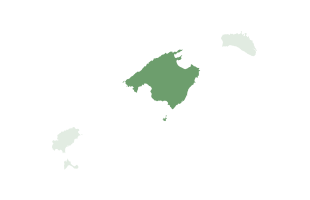
Mallorca


