



- Home
- EXPERIENCES
- STORIES AND FEATURES
- "THE LOCAL FISHING INDUSTRY NEEDS CONSCIOUS CONSUMERS, NOT TEMPORARY APPLAUSE"
"The local fishing industry needs conscious consumers, not temporary applause"
 REPORT
 REPORT
 REPORT
 REPORT
 REPORT
 REPORT
Domingo Bonnín advocates for the future of the Balearic Sea and those who make a living from it.
Domingo Bonnín is the president of the Federación Balear de Cofradías de Pescadores (Balearic Federation of Fishers' Guilds), a position he renewed in 2023. With decades of experience at sea, he wholeheartedly defends an industry in a silent yet critical crisis. His firm voice denounces bureaucracy and calls for a society that truly supports those who provide fresh fish in the Balearics.
How would you describe the current state of the Balearic Islands' fishing industry?
It's a mixed picture. On the one hand, marine resources remain in good condition. But on the other hand, we're seeing a loss of fleet and staff, not because of the sea, but because of excessive bureaucracy. We currently have 266 professional vessels spread across 16 major ports in the islands. The fleet is very small compared to other parts of the peninsula.
What are the main challenges you face as a Federation?
The main difficulty is that fisheries policy is decided in Brussels, where they lack insight about the situation on our islands. Standards are designed for Northern European fleets, which are much larger and different from ours. We do things by the book, but end up being locked into rigid regulations that don't match our scope or conditions. This is compounded by poor understanding from Madrid and a local government that lacks real power.
How has the Balearic fleet evolved in recent years?
In 1975 we had more than 1,300 boats and over 3,000 professional fishers. Today, there are fewer than 270 boats and just 460 fishers left. We have always been the smallest fleet in the Spanish Mediterranean, meaning we have minimal impact on the sea. We don't export large quantities; what we catch is consumed on the islands. Only species such as sardines, anchovies and tuna are exported, as we have a decent amount of resources and a reasonable haul.
What are the most typical species around the Balearic Islands?
Although many Mediterranean species are common, in the Balearics we have products that are closely linked to local identity. Some of the top species are the red prawn, lobster, cuttlefish, transparent goby and common dolphinfish, which is particularly typical of Mallorca. Not because it doesn't exist on other islands, but because it's traditionally been fished here. This cultural heritage has a strong influence on what's caught and how it's cooked.
And how would you rate the health of Balearic fishing grounds?
I'd say it's excellent. Our fishing intensity is very low, and our community is the largest marine protected area in the whole of Spain. This creates a balance between what's caught and what's kept. It's like farming: you have to keep some seeds to keep the harvest going. In our case, the sea remains productive thanks to this responsible management.
What role does trawling play in this situation?
It's key. Trawling is the source of 70% of the locally-caught fish we consume here. If this method were to disappear, we wouldn't be able to maintain our business structure or guilds. Many species such as the red prawn, octopus, red mullet and hake require this fishing technique. Modern trawling also faces strict controls: electronic logbooks, GPS, black boxes, etc. It's one of the most controlled areas of fishing today.
Is there environmental awareness among fishers?
Yes, of course. The mentality has changed a lot. I started fishing in the 80s and I've seen that change. Those of us at the helm today grew up with greater social and environmental awareness. We're not an isolated industry, we're a part of society. Today, caring for the sea isn't just a narrative, but a necessity that we pursue every day.
What can society do to support the local fishing industry?
Consume local products, directly. Go to the municipal market, buy from local shops, look for local fish. In the pandemic we were essential, we went out fishing when everything stopped. But today, no one remembers. People clapped from their balconies, but now price and convenience are once again being prioritised over source and quality. Support must be ongoing, not temporary.
And how do you see the future of the industry? Is there a generational change?
It's worrying. Fewer and fewer young people are getting involved because fishers are losing their credibility. We're branded as destroyers when here we work carefully. We would need a major publicity campaign to highlight the work of the primary sector. If we don't, fishers will disappear, along with our food sovereignty.
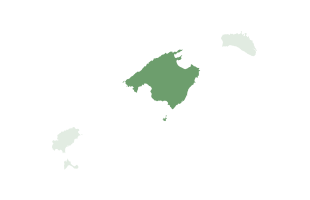
Mallorca


