



- Home
- EXPERIENCES
- STORIES AND FEATURES
- "THE BEST ENSAÏMADA IN THE WORLD COMES FROM INCA"
"The best ensaïmada in the world comes from Inca"
 REPORT
 REPORT
 REPORT
 REPORT
 REPORT
 REPORT
The baker from Inca who blew up Instagram with his traditional kneading.
Joan Seguí is in the fifth generation of his family at the helm of Forn de Sant Francesc, a century-old bakery in Inca that successfully combines tradition and modernity. In his wood-fired oven, he makes brown bread, ensaïmadas and puff pastries, sticking to traditional recipes, while blowing up social media with more than 370,000 followers. Awarded the prize for the Best Ensaïmada in the World in 2017, today he passionately advocates for craftsmanship and local products.
What are your earliest memories of the bakery?
My childhood memories are all about the bakery: dough, customers coming in and out, time spent with my parents. I remember when my father used to ask me to scrape the trays. Now, this is all part of my working life.
Did you always know you’d take over the family business?
Not at all. In fact, it always seemed clear to me that I didn’t want to do this. My parents didn’t push me to do it either, they encouraged me to study and find another path. But when my father had surgery at 51 years old, he couldn’t carry on, so we had to make a decision: either we’d take over or pass the baton. My wife and I decided to give it a go, and although I came from a completely different industry, we went for it. Now we’re doing great there. It’s been an important, enriching turning point in our lives.
What values did those before you pass on to you?
Above all, commitment to a job well done. I was taught that there’s always room for improvement; you should never settle. My father used to say ‘use gold and sell silver’, which is his way of saying: give your best, do your best, then sell whatever comes out. And another important thing: don’t skimp on the quality of ingredients. These principles still apply to everything we do.
Have you changed recipes or processes over the years?
No, we’re sticking to traditional methods. We could’ve automated some processes or used controlled fermentation, but we prefer to make everything fresh on the day, without preservatives or improvers. This means that, for example, our ensaïmadas don’t last a week, but 24 or 48 hours in optimum conditions. But it’s precisely this freshness that we value and defend; that’s our vision. Our aim isn’t to extend the life of our products, but to ensure they’re authentic.
And does the wood-fired oven you still use make a difference?
Yes, absolutely. We use a Moorish wood-fired oven for our bread. It requires more work: lighting it, keeping the fire going, controlling the temperature by hand... But the result is worth it. The bread has a flavour, texture and aroma that you can’t get from modern ovens. A lot of customers come in just for this bread, which reminds them of the bread of the past. It’s a hallmark of our identity.
What are your most popular products?
Wood-fired bread is, undoubtedly very popular. Then there are ensaïmadas, which we make with less butter, like brioche, lighter and more balanced. People come from all over just for those. And then there’s puff pastry, which is perhaps our leading product. It’s an inverse puff pastry, made with butter and no additives, which stays crispy for days without needing to go in the fridge. It’s completely homemade and makes a big difference.
In 2017 you won the award for the Best Ensaïmada in the World. What was that like?
The competition was about recognising the best ensaïmada among bakeries from all over the world, including Barcelona, Argentina, etc. We entered without really knowing how it would go, because it was the first time it’d been done, and we went through three phases until we won. It was a surprise and an honour. The consequences were brutal: for three months we were overloaded. We had to work on orders days in advance, but the best thing was that people kept coming back. We were really pleased about that.
How do you manage to balance innovation and tradition, especially with ensaïmadas?
It’s simple really: we don’t change the base of the traditional recipe, we just add different fillings. This allows us to maintain their essence while attracting new customers. When we started, ensaïmada was something we hardly sold, only on weekends to elderly people. Adding fillings like Ferrero, pistachio and Kinder attracted a younger crowd that began to see it differently. Today it’s a dessert often eaten at celebrations. We haven’t abandoned the classics, we’ve simply expanded their reach.
What role has Instagram played in your growth?
It was unexpected, but very important. We started by uploading photos without any intentions and the response was immediate. Over time we saw that people were waiting for our posts, they would ask us about it if we didn’t upload anything. That made us take it more seriously because we could see they were interested. Now, we use it to show the real process behind our products: what you see on social media is what you find in the shop. And it works: some people have come from cruise ships just to see us. It’s a very powerful tool for connecting with customers and offering transparency.
Do you manage your pages yourselves?
Yes, we’ve always done it ourselves. We believe it’s essential to keep in close contact with the customer. When someone sends a message, a real person in the bakery responds. It also lets us better manage product availability. If we post a pistachio ensaïmada, it’s because we know they’re available on those days. We don’t promise anything we can't deliver, and that builds trust.
Do you think Instagram helps to promote Mallorcan baking?
No doubt about it. We’re not inventing new products every week, but we’re reminding people what we have and presenting it in an attractive way. If we post a certain filled ensaïmada, its sales might skyrocket that week. That shows there’s interest, that people see it and want it. In this way we’re giving visibility to traditional recipes that may have been forgotten by younger generations.
Do you work with local products?
Yes, as much as we can. Our flour is from Mallorca and so are most of the ingredients. It’s a commitment to the land and a practical advantage: if your supplier is nearby, you get fresh produce right away. You’re not dependent on boats or long-distance transport. And it helps to boost the local economy.
How important is it to keep bakeries like yours going?
Really important. In the last decade, more than 100 bakeries have closed across the Balearic Islands. It’s very sad. That’s why we believe in upholding this craft: if it disappears, we lose culture. In the beginning it was hard to compete with big supermarket prices, but now there’s more awareness that buying industrial bakery products is not the same as buying artisanal ones. It’s a trade that needs defending and respecting, like that of a carpenter or an electrician. These are core professions.
How do you see the future of the industry?
With worry. The biggest problem is the lack of people in next generation wanting to take over. Many close because no one wants to continue. And the same thing happens when we’re looking for workers to hire, people don’t even show up. There’s a misconception that it’s a very hard or badly paid job, and this drives away potential apprentices. We’ve seen it ourselves: for the last two job ads, only two people applied. It’s a symptom of a wider problem. The future of traditional bakeries is uncertain.
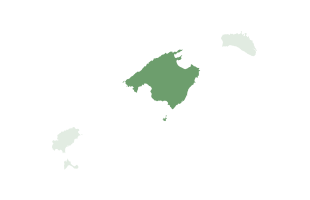
Mallorca


