



- Home
- EXPERIENCES
- STORIES AND FEATURES
- SON MUT NOU: A PARADISE IN MALLORCA PROTECTING THE SOUL OF THE BALEARIC FIG TREE
Son Mut Nou: A Paradise in Mallorca Protecting the Soul of the Balearic Fig Tree
 REPORT
 REPORT
 REPORT
 REPORT
 REPORT
 REPORT
In Llucmajor, Montserrat Pons looks after the largest collection of fig trees in the world.
A pharmacist by trade and a botanist by vocation, Montserrat Pons i Boscana has turned his estate, Son Mut Nou, in Llucmajor, into the largest living museum of fig trees in the world. There, he grows more than 3,200 trees of 1,486 different varieties, many of which are at risk of being lost. Under the shade of one of his fig trees, he spoke to us about this one-of-a-kind venture, his backstory and identity.
How did your bond with fig trees come about?
Although my profession is pharmacy, botany has always been a great passion of mine. By the time I finished university, I’d already inherited some fig orchards from my parents and grandparents. I started by taking care of old varieties from Llucmajor, then I began to focus on the whole of Mallorca. The fig tree is the oldest fruit tree recorded on the island, introduced by the Phoenicians. It has a deeply symbolic meaning: I always say that it’s ‘the poor man’s bread and the rich man’s dessert’, which perfectly captures the place it has in our history.
Did your family influence your love for the land?
Absolutely. My grandfather and mother were farmers. Since I was a child I’ve been around fig trees, pigs, jams, dried figs... everything to do with the countryside. This experience sparked a feeling of attachment in me that eventually grew into my passion. I feel like I’m heir to a Mallorcan identity closely tied to figs and their uses. What started as a family thing became a cultural cause.
How would you describe the activity at Son Mut Nou?
This year marks 30 years since my collection began. Today we have more than 3,200 fig trees of 1,486 varieties, 253 of which are native to the Balearic Islands. Many are at risk of disappearing. Son Mut Nou has become the largest private collection of fig trees in the world. Here, we don’t just grow trees, we preserve natural and agricultural heritage that’s gradually being lost due to globalisation, tourism and neglect of the rural world.
What challenges have you faced along the way?
So many. In the beginning I looked for varieties mentioned in books from the 19th or early 20th century. I’d drive to farms, talk to farmers and owners until I found the types I was looking for. It was kind of like archaeological research. In 1995 I began to organise this collection into a system. Today, many of these varieties have been saved from disappearing, but behind them are thousands of hours of work.
What does Son Mut Nou mean to you?
It’s my paradise. Before it was just a field where I came to hunt or look after the old fig trees, but over time it became my life’s work. Every one of the 3,200 fig trees here is like a daughter to me. I would never sell this farm because it’s part of who I am. For as long as I live, this place will remain a paradise. It’s much more than just an orchard: it’s family, legacy and emotion.
Do you have a favourite variety?
It’s hard to choose. It’s like asking which is the best painting or the best artist. I have a soft spot for varieties from Llucmajor, because of how old they are and the fact they’re part of my town. But every ripening stage—early, August, late and winter varieties—has its own gems. At each stage there are varieties that I appreciate for their taste, texture, history... there’s no single favourite.
Why’s it important to preserve these varieties?
Because we’re losing our agricultural tradition. We do school visits, and 99% of children aged 12 to 14 don’t know about fig trees or have even tried a fig. Our generation had a different kind of connection with fruit trees. If we don’t preserve these varieties, they’ll disappear along with a certain way of life. It’s cultural, agricultural and historical heritage that urgently needs to be protected.
What’s different about figs from Mallorca compared to those from abroad?
A lot. Here we have native varieties that have been adapting to our climate and soil for centuries. Figs from other places like Syria, Greece and Israel may be good, but here our ones are sacred. Foreign varieties even improve when planted here because of the sunlight, climate and soil. But the best, without a doubt, are the Balearic ones, especially from Mallorca. They’re the result of centuries of natural selection.
How did your figs get into haute cuisine?
With great pride. Chefs such as Andreu Genestra and Maca de Castro work directly with our varieties. They use our figs and by-products to make unique dishes. Also, at Son Mut Nou we make 21 different artisanal products: fig bread, oil, vinegar, pâté, ice cream made using five varieties... This gives us some income to keep the business going.
Do you think figs are appreciated in Balearic cuisine?
Unfortunately I don’t. There’s hardly any local produce to be found at local markets. And dried figs are no longer found in restaurants. They’re a forgotten product. Balearic cuisine is yet to rediscover the fig’s full potential. We need more promotion and commitment to local produce.
And in Mallorcan society in general? Are figs appreciated?
Not enough. Foreigners who come here show a lot of interest: last year 3,000 people came, and only 10% were from Mallorca. They come from England, Germany, Thailand and the United States to learn about our fig trees. But there’s a lack of awareness here. At Son Mut we’re trying to bring varieties back to their original areas, to promote cultivation, but I struggle to do this practically alone.
How do you see the future of the fig... and of the countryside?
Complicated. The countryside is generally at risk of cultural extinction. In Porreres, for example, apricots are disappearing, when they were once a token product. The problem is extreme. People care more about the beach than the countryside. But this isn’t a theme park with swimming pools; it’s our livelihood. We need to boost consumption, cultivation and appreciation... or it’ll disappear.
And will the next generation take over at Son Mut Nou?
That’s the big question. I have five granddaughters and one grandson. They’re still little, and although they come every Saturday and I instil this love in them, I don’t think they feel the same as I do. My children help, but they don’t have this passion. For this to keep going, an institution would need to take over one day. I’ll be here as long as I live, but the future’s uncertain. It’s not bleak, but it is cloudy.
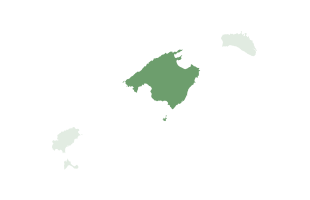
Mallorca


