



- Home
- EXPERIENCES
- STORIES AND FEATURES
- SA POBLA POTATO: JOAN CANTALLOPS AND A COLLECTIVE COMMITMENT TO A SPUD WITH IDENTITY.
Sa Pobla Potato: Joan Cantallops and a Collective Commitment to a Spud With Identity.
 REPORT
 REPORT
 REPORT
 REPORT
 REPORT
 REPORT
The manager of Illacamp backs a cooperative model that unites tradition, quality and zero-mile food.
Joan Cantallops runs Illacamp, an agricultural processing company created in 1999 by several families from Sa Pobla to boost the cultivation of potatoes and other crops from Mallorca. From storehouse to market, Illacamp ensures technical control and circular economy principles throughout the process. Cantallops, a son to farmers and a trained technician, explains how this initiative has modernised a crop with 180 years of history behind it, today threatened by climate change, pests and the lack of a new generation to take over.
What was your earliest experience of the countryside like and what brought you to Illacamp? I’m a son to farmers, so the countryside has always been part of my life. After finishing my studies, I joined Illacamp, a farmers’ co-op that several families from Puebla founded in 1999 to better defend the marketing of their potatoes. My day-to-day work is economic, financial and commercial management, linking members—the producers—with the different sales channels. What makes Illacamp stand out in Sa Pobla’s potato industry? Structurally, we operate as a modern cooperative: we advise farmers; centralise the classification, packaging and delivery of produce; and we’ve started a freshly prepared food line for hotels and restaurants. This ensures consistent quality, traceability and, above all, negotiating strength in a market where it’s difficult for isolated producers. The Sa Pobla potato is internationally renowned. What makes it special? Historically, we’ve been Europe’s leading potato-growing region: we harvest new potatoes at the end of March–April thanks to a mild microclimate, plenty of water and clayey soil that adds flavour. Most of this ‘extra-early’ harvest used to go to the United Kingdom; today, it’s exported to Eastern European countries, Germany and Denmark. In summer we let the same potato ripen for domestic consumption on the island, linked to the tourist season. What do customers get when choosing Sa Pobla potatoes over another kind? Potatoes can be grown in many places, but the Mallorcan potato is a tender tasty spud thanks to the hard, clayey soil conditions here. It’s an intensive crop in Sa Pobla, as, although there’s increasingly less of it, for the moment we have plenty of water. Also, as it’s zero-mile produce, it arrives fresher. Are there stand-out varieties today? Decades ago everyone asked for two or three specific names; now there are thousands of varieties, it would almost be unfair to single out just one. They’re evolving and adapting to correct defects and adapt to current field conditions, such as heat, lack of water and new pests. There’s no one variety that dominates over others right now. What are the biggest challenges of cultivation? The main challenge is the increasing restriction of pesticide products due to EU regulations, which makes production difficult. We deal with nematodes and wireworms that attack potatoes and make them unfit for sale. This is made worse by rising costs, the break-up of smallholdings and the lack of young farmers. If profitability fails to balance out, the crop will disappear. Can potatoes be a sustainable crop in this context? Certainly. In fact, we’ll have to make it so if we want to continue producing potatoes. However, we have a number of disadvantages such as land scarcity, the fact that fields are smallholdings and restrictions on pesticides. This creates a difficult market situation for farmers, who are expected to produce a high yield, because these drawbacks drive up costs and make profitability more difficult. The final price can’t be touched because it’s set by the market. Beyond potatoes, what other produce does Illacamp handle and which markets do they reach? Onion is our second crop and there’s some citrus fruits and vegetables, albeit residual. We sell mainly to large supermarkets on the island, the hotel and catering industry, wholesale markets such as Mercapalma and local markets; a small part goes abroad. How do you rate the tourism industry’s support for local produce? Tourism should be a driving force, but many hotels buy on price. If they use local produce, it’s because the circularity law has a 3% produce requirement, but this isn’t the norm. It’s true that some produce isn’t grown in Mallorca or there’s not enough of it to supply the whole industry, but this isn’t the case for potatoes. Serving the hospitality industry is therefore clearly important, but it could be more so. Why’s it important to consume local produce like potatoes? It’s key both to maintaining local crops and to supporting kitchens in restaurants and hotels in terms of Mallorcan cuisine. Although potatoes are widely consumed on the islands, they tend to be more low key; there are other products that are more eye-catching and iconic. Even so, potatoes must be given the importance and promotion they deserve. Looking to the future, how do you see potato production in Sa Pobla? Right now, the crop is at risk. There are real threats: soaring costs, pests that are hard to control, and a lack of people in the next generation to take over. If we don’t make it profitable, the crop will disappear. I suppose it’ll be solved little by little, but it’s a slow, complicated process.
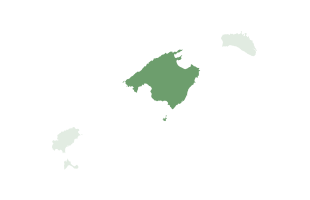
Mallorca


