



- Home
- EXPERIENCES
- STORIES AND FEATURES
- "ORGANIC LAMB FROM MALLORCA IS GOOD FOR OUR HEALTH AND THE LANDSCAPE"
"Organic lamb from Mallorca is good for our health and the landscape"
 REPORT
 REPORT
 REPORT
 REPORT
 REPORT
 REPORT
Magdalena Adrover, a vet at the Association of Organic Farming in Mallorca (APAEMA), backs a sustainable livestock farming model.
A vet by trade and a passionate advocate of organic farming, Magdalena Adrover has been working for almost a decade at APAEMA with local livestock farmers to improve the quality and value of lamb reared in Mallorca. Through the ME Ecològic project, she promotes a system based on natural grazing, animal welfare and sustainability, whereby 96% of production is already certified as organic.
What led you to specialise in organic livestock farming and to work with APAEMA?
I felt the need to tailor my veterinary training to the current situation of our land. On the mainland, education is very much focused on intensive livestock farming, something that doesn’t make sense here. Seeing how local producers worked sparked my interest in a more sustainable model, and I wanted to be part of the change to bring real solutions to Mallorca’s farmlands.
What is APAEMA and what kind of work do you do there?
It’s an association that brings together organic producers, including both crop and livestock farmers, as well as supporters. We offer expert advice, help those who want to go organic and organise training sessions. We also work to promote organic products in schools and canteens, create awareness campaigns and take part in negotiations with the government.
What does it mean to you to be part of a project like ME Ecològic?
For me, it’s so enriching. Not only on a professional level, but also on a personal level. It allows me to work based on principles I align with, and to advocate for a type of livestock farming that protects our landscape. Crop and livestock farmers are the real stewards of the land, and supporting them also means looking after the environment.
What does your insight as a vet bring to the project?
My role is to support livestock farmers with technical tools that will help to improve their work. It’s not just about producing quality meat, but also making farms financially viable. Those who work with livestock every day should make a decent living from it.
What are the main differences between organic and conventional lamb?
The difference starts with animal welfare: in organic farming, the priority is to respect natural cycles. Their diet is also key, with natural fodder and grass rather than feed. This has a direct impact on our nutrition due to the quality of the meat and its fat content. Moreover, the use of antibiotics and chemicals is greatly limited, which is good for both the customer and the environment.
What are the challenges involved in this type of production in an environment like Mallorca?
The main challenge is changing people’s mentality. Going organic isn’t just about changing the way we think; it’s about understanding and working with the ecosystem. If a farm has natural grass, it should be used, with less dependence on external inputs. Real sustainability means learning to manage what we already have and aiming for self-sufficiency.
How has the ME Ecològic project evolved since it first started?
It came about because lots of organic livestock farmers couldn’t find a market and had to sell their lamb as conventional. The project created a brand and a cooperative to give them an outlet and recognise their value. In 10 years we’ve gone from marketing just a small percentage as organic to 96% of the cooperative’s members. This is a hugely significant step forward.
What slows the project’s growth today?
Infrastructure. There are only two slaughterhouses in operation on the island and the one we work at, in Felanitx, has limited resources. They do the slaughtering, but we can’t expand production due to lack of capacity. The solution would be to have our own processing centre, adapted to our needs.
How big is the current demand for organic lamb?
Private consumption is still low and seasonal, but there’s been growing interest from the hospitality industry and some hotel chains. Chefs who value the quality of ingredients, school canteens and conscious customers are demanding it more. Even so, with so many tourists and hotels, it’s frustrating to see how little impact it has on the island. We have to keep working to change that.
Why is it so important to keep this type of product local?
Because it's not just about meat, it’s about maintaining households, protecting cuisine and managing the landscape. Local farms can’t compete on price against intensive industry from abroad, but they provide enormous benefits: quality, sustainability, fire prevention, natural fertilisation... All this needs to be considered when choosing what to buy.
What can be done to make people understand all this?
We continue to back awareness campaigns, publications, talks, social media campaigns... And now we’re also updating our website to make it more informative. Our aim is for those who eat organic lamb to know what’s behind it, and that it’s not just a question of price, but of its positive impact on the island.
What would you like the future of organic lamb in Mallorca to look like?
I would like all lamb that is already produced organically to be sold as such, at a fair price. Livestock farmers should be given the recognition they deserve for their work and society should understand that their role is essential. Only in this way can these farms be kept alive and continue to care for the landscape we all love.
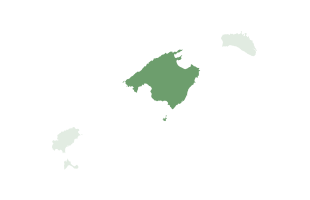
Mallorca


