



- Home
- EXPERIENCES
- STORIES AND FEATURES
- “CULTIVAM EL GUST D’ABANS”
“Cultivam el gust d’abans”
 REPORT
 REPORT
 REPORT
 REPORT
 REPORT
 REPORT
S'Hortolà keeps the countryside tradition alive with authentic local produce.
Margarita Cirer is part of the third generation to run S'Hortolà, a family farm located in Pla de Sant Jordi. Together with her siblings, she continues a century-old legacy of growing seasonal produce with authentic flavour, caring for the land through sustainable techniques and defending the importance of direct contact with customers.
How was S'Hortolà born?
S'Hortolà is a continuation of our grandparents’ and parents’ work. We don't call it a "business", but a trade that’s been passed down from generation to generation. We three siblings have brought a modern touch to this work with greenhouses and irrigation systems, while still respecting what they started.
You’ve made the slogan "cultivam el gust d'abans" your own. What exactly does that mean?
It’s a very Mallorcan phrase that refers to the taste of the past, of authentic flavour. Our produce—tomatoes, potatoes, melons—tastes like what it’s supposed to taste like. They smell and taste like they did long ago. That authenticity has been largely lost in modern farming.
How do you manage to preserve that traditional flavour?
We still use traditional cultivation methods, avoiding hydroponic techniques. We care for the land with great care and constantly regenerate it. Water quality also plays a role, as it has certain saline properties that enhance the taste. We’re not aiming for the perfect size, we’re aiming for flavour.
You even maintain a traditional windmill. Why?
Because it’s part of who we are. The windmill we use to draw water from the well not only saves energy, it also symbolises our ties to the land. We’d completely restored it, but it collapsed after a storm, so we decided to rebuild it. Not for profitability, but for identity.
What values did you inherit from your family?
Above all, sacrifice and love for the land. In the countryside you work long hours, with no set schedule. It takes total dedication. Farming doesn’t provide immediate benefits, but it supplies food and is essential. This is sometimes forgotten in a society that prioritises fun and consumption.
What’s it like to work with your siblings?
We understand each other well. Each of us has a part to play: production, customers, sales. We’re a close family and we share common goals. In this type of business, if there’s no family trust and commitment, it’s very difficult to move forward.
What kind of produce do you grow and what’s your leading crop?
Always seasonal products. In winter, leafy vegetables such as chard, spinach or cabbage. In summer, tomatoes, melons, watermelons, courgettes, etc. But our prized crop is the potato, available all year round, always with the same flavour and a lot of customer loyalty.
Do you feel that customers value direct contact with the producer?
Very much so. Our customers seek quality, know what they’re buying and value personal service. Some people even come specifically to our stall at the Mercat de l'Olivar. We don’t have the opening hours of a supermarket, but we do have a very direct and loyal relationship with our customers.
How do you see the future of local produce in Mallorca?
It’s really difficult for small and medium-sized producers. There are three or four big companies that’ll eventually take over the market. The problem is that everything’s measured by price, not by quality or effort. This is unsustainable.
How did you make the leap to become digital?
During the pandemic we set up a delivery service and it worked very well. Then we stopped it due to lack of resources, but we launched the online shop. We don't have the logistics to compete with big companies, but a girl on our team really helped us increase our visibility on social media and online.
What motivates you to keep going?
The truth is, it’s becoming more and more difficult to find motivation. The countryside takes it out of you. I’ve taken time away from my family, from my personal life. This is a profession you have to love, not for what it brings you materially, but as your calling.
And what will the future bring for farmers in Mallorca?
A few big companies will keep going. Farming needs huge investment, especially now thanks to climate change. To produce in extreme conditions you need technology, microclimates and engineering. We’ll stick to tradition, right to the end.
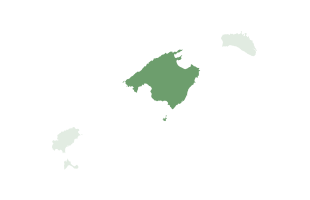
Mallorca


