


- Home
- LOCAL PRODUCE
- DESIGNATIONS AND BRANDS
- VI DE LA TERRA FORMENTERA
Vi de la Terra Formentera
Protected geographical indication
 Protected geographical indication
 Protected geographical indication
 Protected geographical indication
 Protected geographical indication
 Protected geographical indication
 Protected geographical indication
A sensory journey through the smallest, most enchanting island of the Balearics
Formentera, a tranquil treasure of the Mediterranean, is famous not only for its pristine beaches and natural landscapes, but also for its winemaking tradition that dates back to the 13th century. ‘Vi de la Terra Formentera’ wine encapsulates the heart of the island in every glass, with wines that reflect its history, climate and ancestral cultivation techniques that have lasted centuries.
Formentera, the smallest and southernmost Balearic Island, has a rich winegrowing history dating back to the Middle Ages. The first documented reference is found in the Feudal Charter of 1246, which mentions vineyards in La Mola. Although the Black Death in the 14th century temporarily depopulated the island, vine cultivation was revived in the 18th century with the repopulation of the island by Ibizans. By the 19th century, wine production had grown significantly, supported by the Ca'n Marroig winery and maritime trade.
Throughout the 20th century, winegrowing in Formentera faced great challenges, but the opening of Juan Riera Mayans' winery in 1972 marked a revival of the local wine. Today, winegrowing is one of the main agricultural activities on the island, with more than 60 hectares of vineyards representing 12.5% of agricultural land. The Monastrell variety is the most common, with 44% of the total number of vines.
Formentera is unique in terms of its geography and climate. La Mola and Cap de Barbaria are the most high-up areas, while El Pla connects these headlands with dunes and small valleys. The soils are predominantly sandy and clay-rich, ideal for vine cultivation. The dry subtropical Mediterranean climate, with hot, humid summers and mild winters, together with the scarcity of rainfall concentrated in autumn, provides perfect winegrowing conditions.
Cultivation practices on Formentera remain traditional, focused on growing grapes of the highest quality. Planting density does not exceed 5,000 vines per hectare, with a maximum of 60,000 buds per hectare and a maximum production of 8,500 kg per hectare. The permitted grape varieties include Monastrell, Fogoneu, Tempranillo, Cabernet Sauvignon, Merlot and Syrah for reds, and Malvasia, Prensal Blanc, Chardonnay, Viognier, Grenache Blanc and Muscat Blanc for whites.
Formentera wines are known for their brilliance and clean, bold aromas. The red wines made from Monastrell grapes are particularly appreciated for their cherry colour, aromas of ripe fruit and sweet strawberry, and distinctive notes of thyme, which is traditionally used to prevent clogging in the fermentation vats. The palate is dense, round and warm, with a long, fruity finish. The white wines, especially those made from Macabeo, are lemon or straw-yellow in colour with aromas of apple and flowers, and are fresh and balanced on the palate.
'Vi de la Terra Formentera' wine is marketed exclusively as bottled at source, guaranteed by an official control number assigned by the Institute for Food Quality (IQUA). This control system ensures that each bottle preserves the authenticity and quality of Formentera wines.
Each glass of ‘Vi de la Terra de Formentera’ lets you discover a sensory experience that transports you to this magical island, where the wine heritage blends with breathtaking landscapes and a culture rich in history.
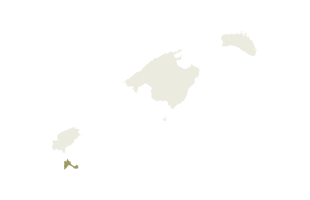
Formentera